
ROCK CREEK HOUSE
Originally published in Architect Magazine, January 2017
Ian Volner

Nader Tehrani was born to roam: Raised by diplomat parents who bounced between the U.K., U.S., and their native Iran, the 53-year-old architect and his firm, NADAAA, have exhibited an intellectual approach that finds opportunity for function and signification in such disparate locales as Gwangju, South Korea, and Newton, Mass. Since being named Cooper Union’s dean of architecture, Tehrani has continued to push his office forward while swinging between studios in New York City and Boston, and his ability to marry pedagogy with practice is borne out in a project completed this year: a house in Washington, D.C.
An expansion of a 1920s structure on the edge of scenic Rock Creek Park, the house shows how Tehrani can train his mental firepower on the domestic concerns of an affluent family in a quasi-suburban setting. Expanded from two levels plus a basement to four finished floors, the building’s brick envelope is the launching pad for an irregular pattern of windows that hint at the new and more sectionally complex interior: a warren of nooks and crannies, of private spaces that peek into public ones, and of privileged views into the park beyond. “We basically kept the ghost of the existing order,” says Tehrani, who kept most of the rooms in or close to their original alignment.
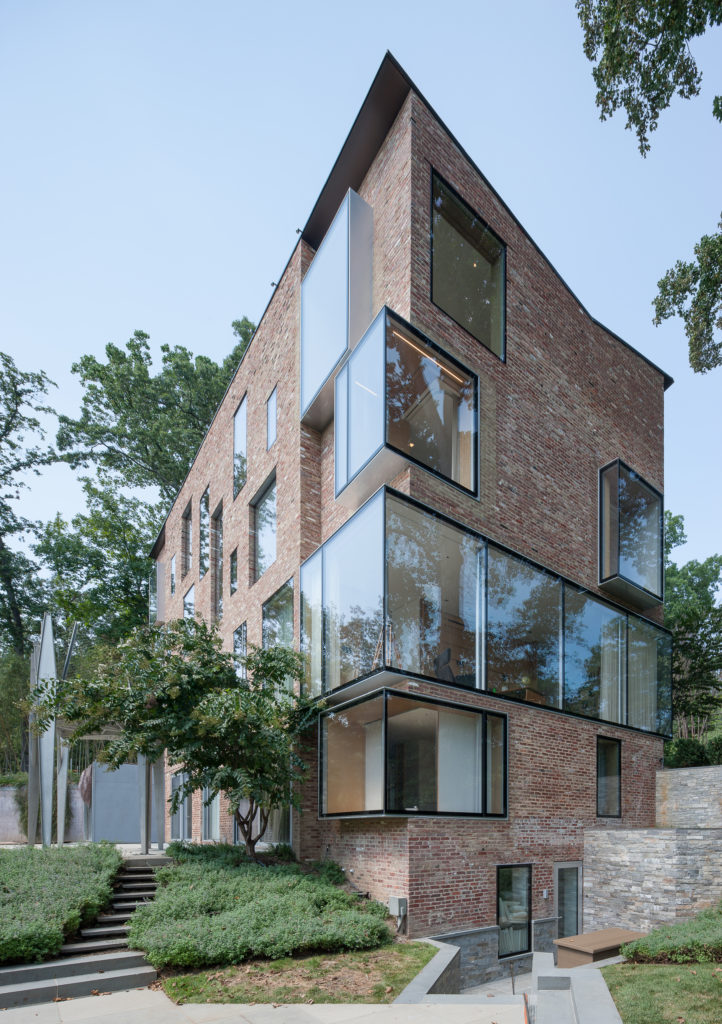
The biggest shift by far is in the northeast garden façade, which ceased being load-bearing and became a curtainwall. “A reconstructed Frankenstein monster,” as Tehrani calls it, the approach allowed for even more windows, the new openings furnishing castoff bricks used to pop up the attic into the new upper floor.
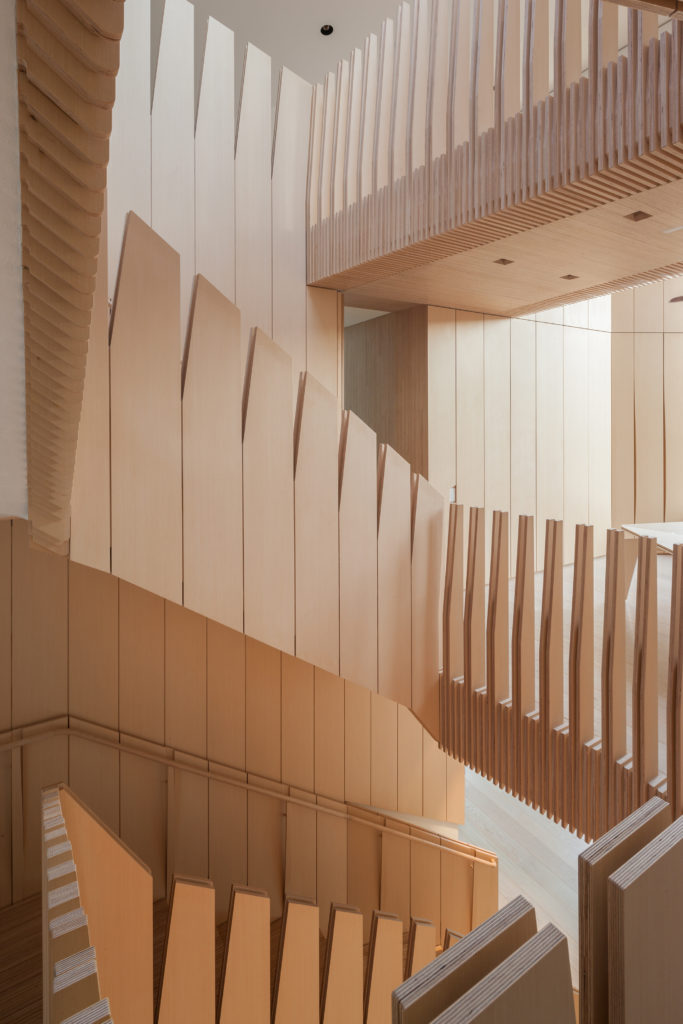
The house’s signature moment—if NADAAA can be said to have signatures—is in the central stairwell, a bristling array of wooden banisters. Aesthetically and practically, it recalls the vertical metal louvers in the firm’s Melbourne School of Design (with John Wardle Architects), with warmer materials and more subdued details as befits a residential project. Everything about the house, in fact, seems to find Tehrani in a more toned-down mode. “What we’re doing nowadays is decomposing, erasing, curating,” he says. “We’re eliminating the marks, so you come and pay attention to the irreducible aspects of the project.”