MELBOURNE SCHOOL OF DESIGN
MELBOURNE, AUSTRALIA | JOHN WARDLE ARCHITECTS AND NADAAA
Originally published in THE PLAN, No. 080, 2015
Paulo Conrad-Bercah
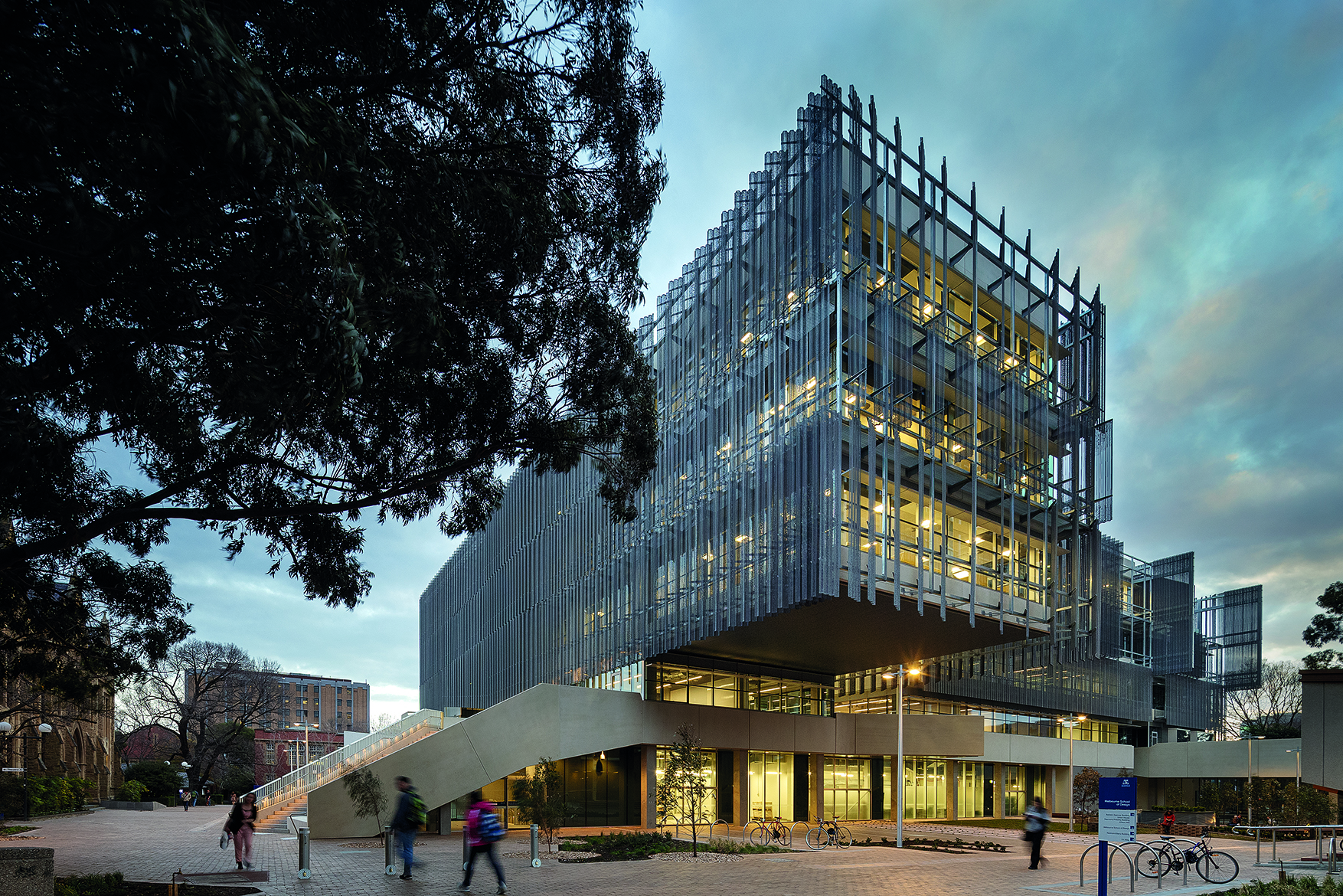
Photo: John Gollings
We are all aware that ours is an era in which an increasing number of people lay claim to the title of an “artist” to satisfy an overweening “vanitas”—a disease Montaigne considers the ultimate soul-destroying human trait.
It’s a disease that has contaminated the world of architecture for more than twenty years, spread by the “starchitect” phenomenon in which the graceless iconic creations of self-styled debunkers of all-pervasive corporatism merely peddle the very same pedantic mindset, hailed by the compliant media as modern masterpieces.
We all know this phenomenon has thrown up a series of brash intrusive architectures, paradoxically legitimated by groundless arguments, faulty thinking generally harbouring nihilism and related cynicism, made all the more overbearing—as Karl Kraus noted—by the ostentation with which an urn is used as a chamber pot and a chamber pot as an urn.
Recent years have produced several variants on the same theme, largely in the wake of the tight economic situation. These vary from minimalism, hailed with religious reverence, to a new innocent pauperism imposed by circumstance, and as such, considered an antidote to the “vanitas” members of the dominant yet rarefied “Davos Culture” (thank you Samuel P. Huntington!) still continue to express.
In this scenario of intensified extremisms, the recent inauguration of the Melbourne School of Design, the MSD, seems to offer an invigorating way forward.
The simplicity of the architectural choices recall to the happy few still able to distinguish a chamber pot from an urn the fundamental elements that should inform the architect’s work – elements that today have been swamped by digital rhetoric. The MSD reminds us that:
- Architecture stands apart from the other arts for its scale, and because of this, to be understood, requires a different timeframe than the other arts;
- Architecture cannot be discussed as if it were an object since that would make it unintelligible; only if lived as a pragmatic experience can the complicated and sophisticated mediation negotiated between interiors and exteriors be fully understood;
- Experiencing architecture is first and foremost to experience surprise and emotion, triggered by passing from one architecturally created confine to another;
- When all is said and done, architecture is a dramatic genre, a spatial performance, a complex dynamic dialogue staged with a series of well-calibrated contrasting elements – a dialogue to be experienced rather than “resolved”;
- Being an architect means changing a particular landscape into a spatial experience;
- Architecture cannot be discussed in terms of form but only as an immovable spatial organization that lends infrastructure to the lives of human beings who, moving between its confines and experiencing its structural limits, live it as a sort of physical and intellectual gymnasium – an everyday personal experience that is unique and personal;
- A massive architectural work can be made ephemeral by minute attention to detail, the expression of a new digital craftsmanship;
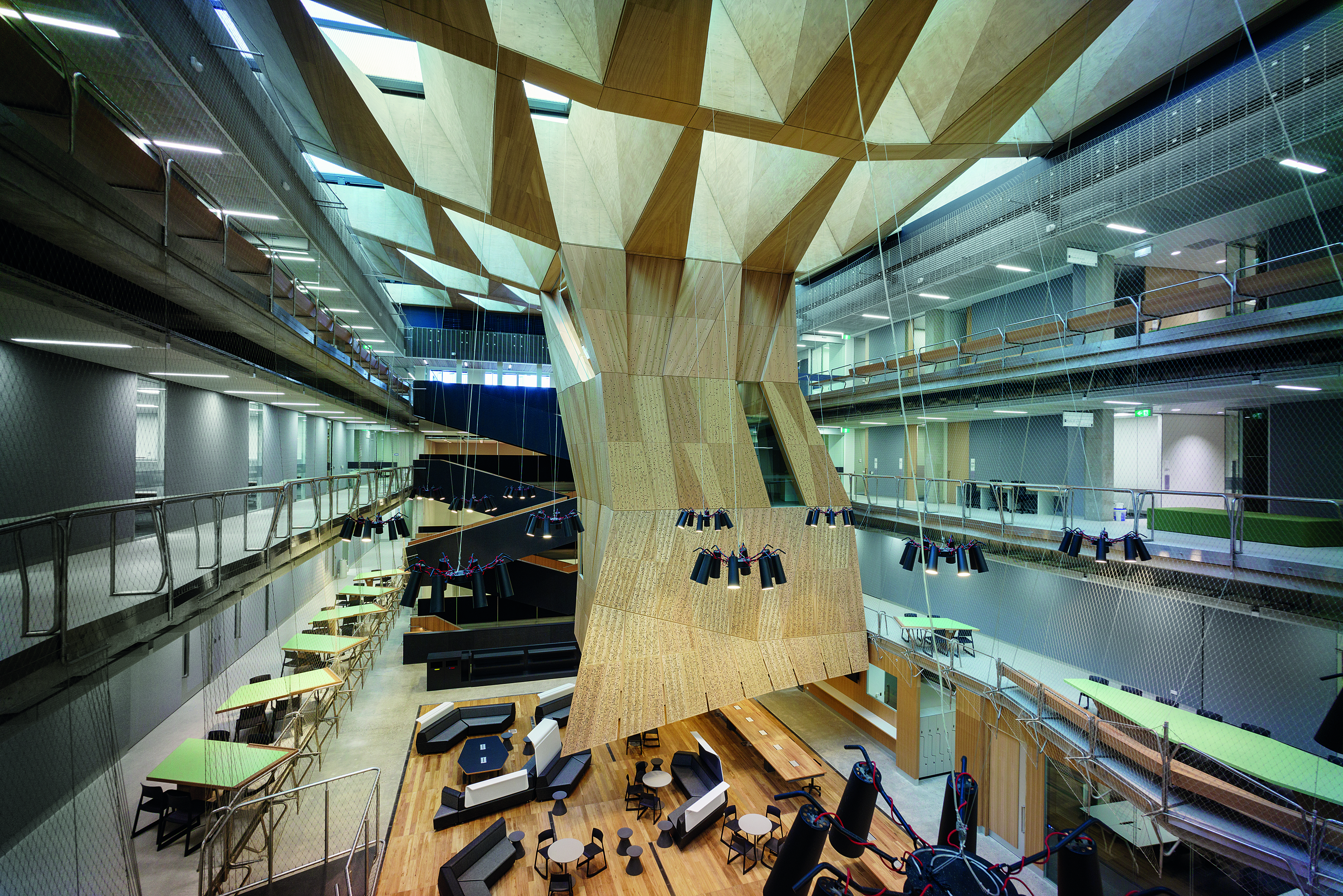
- A discreet outer envelope contrasted by an exuberantly articulated and layered interior offers new insights into the mediation achieved between the building’s nucleus and its envelope – not unlike peeling an onion;
- All those who use up most of their brief’s budget to create iconic, spectacular exteriors are simply working against experiencing architecture. They are “sterilizing” any experience of the interior, making entering the building (and paying an “entrance ticket”) superfluous, just as if a “show” were to take place outside a theatre and not inside on the stage;
- The bad architect can never resist temptation;
- The good architect is able to convincingly mediate between “la physique” and “la morale” in his/her work, in other words, between skepticism and enthusiasm;
- The best contemporary architecture shows a return to physicality.
In a world of architects and clients obsessed with the performance of the outer surface – or its opposite: revealing the logical structure of a work – the MSD stands out as demonstrating a convincing new theorem explaining one of the most intriguing aspects of the complex task that is architecture: that a renewed interest in architecture can be prompted by making the envelope interact with its nucleus in order to create a promenade through the building full of surprises and emotions but where all superfluous additions have been banned.
Sited in the center of Melbourne’s University campus, the MSD is also a gentle public infrastructure where the overtly didactic melds with the social and official functions in the declared aim to trigger a permanent sense of curiosity and, at least for a moment, “distract” both young and old from the permanent distraction of the digital world.
The credit for realizing such a laudable ambition in our low-cost, low-ambition world goes to the insatiable curiosity for their craft of the members of John Wardle Architects and NADAAA. As a team they are unable to say who was the mother or father of their brainchild, the MSD. They have no doubts, however, about who deserves the credit for preparing the ground: Tom Kvan, Dean of the faculty of Architecture, Building & Planning, the proud mastermind behind the Melbourne School of Design.