
BLANK SHOTS: MONOLITHIC DESIRES AND LAMINAR INEVITABILITIES
NADER TEHRANI
The Mono-Medium Ethic
Emerging discussions on mass timber have elicited a wide range of responses that engage topics of building technology, sustainability, and legal codes; naturally, all of these subjects have a substantial impact on design thinking, but if we were to pose the challenge of designing in mass timber more holistically, we might yet establish more reciprocity between the technical and conceptual aspects of this cultural project. In turn, this may prompt a theoretical position that internalizes the technical as part of its intellectual apparatus. Among the many tendencies that characterize design thinking, one stands out from a material perspective: in identifying a single medium through which to work, the architect is able to force invention from within a genre, and in doing so, to radicalize its ability to transform, evolve, and innovate.

The prospect of working in a single medium defies normative architectural thought, in part because of the immediate, practical differences between architectural elements—the ground we walk on, the wall that supports a building, the roof that protects from the elements. The performative requirements of these elements have produced a history of material research and development that has assigned optimal materials to each. For this reason, the repellent qualities of ceramic tiles have been oriented toward roofing and wet rooms, while the sturdiness of stone and concrete with foundations, grounds, and hearths. If indigenous constructions of limited means have not self-organized according to these principles, then architectural theories such as Gottfried Semper’s “four elements” have institutionalized the categorical differences among architectural components, approaches toward material specification, and a decorum toward their functional assignment. As such, working within a single medium runs against the current in the context of theory as well.
There are significant exceptions to this rule, and often they are associated with exceptional constructions, where architecture stems more directly from a local resource, be it the stone of Matera, Italy, or the forests of Kiso, Japan. If the former site produced wonderous archaic excavations, where architectural spaces are extracted from rock, the latter produced an elaborate culture of wood details, evacuated almost entirely of other mediums, creating a syntax of elements that dispense with extraneous mediating joinery; instead, the intelligence of the work stems almost entirely from inventions in wood, with linguistic delight to match. To achieve this, centuries of research went into the extraction of resources, transport methods, the testing of different woods, tooling protocols, and the categorization of joinery details under the stresses of compressive, tensile, and lateral forces. Much work has also gone into finishing processes, differentiating between interior and exterior, protecting against the elements and forces of nature.
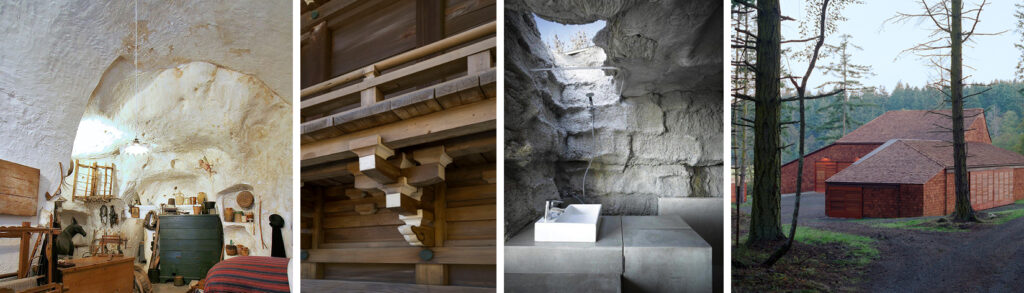
Still, the insistent appeal to a single material medium is fraught with added complexities, most often addressed through architectural amendments and predictable mediations. In Matera, where stone cannot offer human comfort, furnishings, fabrics, and finishes come to the rescue; meanwhile, black terra-cotta tile (Kawara) protects the Japanese temple’s roof from the elements. It is all the more poignant, then, how Ensamble Studio’s Truffle adopts hay bales not only as formwork, but the index of its entire interior finish, or how Thompson & Rose’s Straightsview Barn uses wood shingles for its entire enclosure, without mediating elements, like gutters; such projects display an intellectual insistence that goes beyond the positivism of solving problems.
For these reasons, the predisposition toward the singularity of a material medium is an artifice, and should in no way be confused with nature, nor function. One could claim it is a strategic device, in effect to build adversity from within one’s approach, if only to demonstrate the ingenuity of architecture in response. And in the appeal to parasitic details in support of the host material, the ethic of this philosophy remains intact, precisely because the excursions outside of the medium make no claims to dominance.
The Logic of Strategic Labor
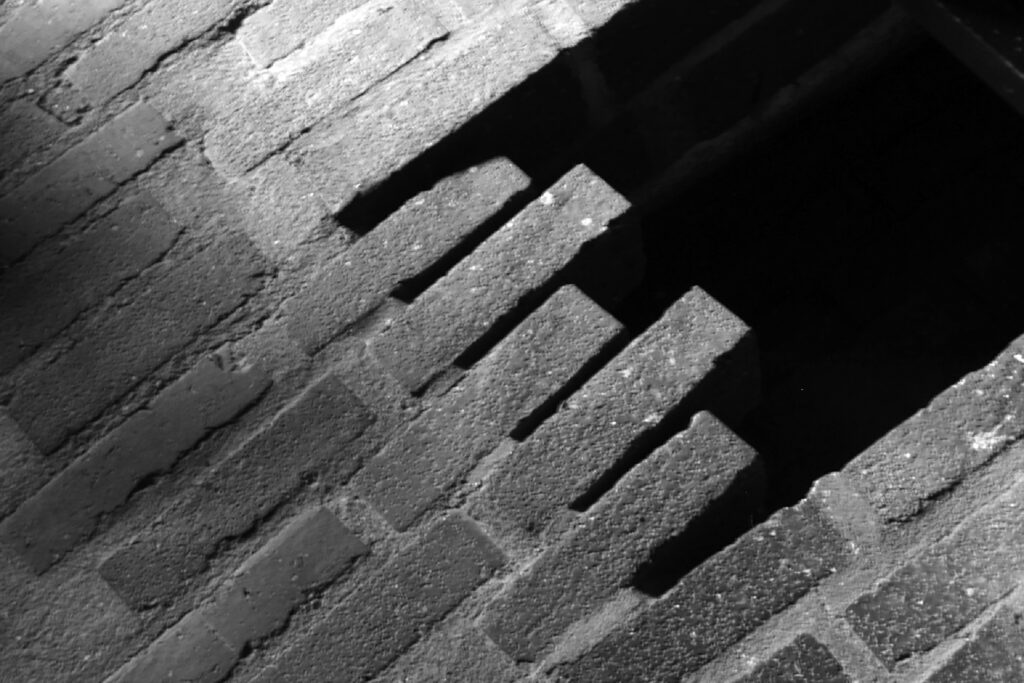
At St. Peter’s Church in Klippan, Sweden, Sigurd Lewerentz adopts brick in its many guises, and with it, the emergence of a language, a discipline, and an ethic. We recognize that its steel structure serves merely as a framework for the brick enclosure; the floors, walls, vaults, and certain key attributes are cast in brick while allowing the introduction of glass, wood, and steel for critical interventions (windows, furnishings, handrails). However, Lewerentz’s use of brick reminds us of the seminal role of mortar. In his refusal to cut the brick (an ethic he imposes on the medium), he is also subsequently required to develop a malleable bonding strategy: the bonding dimension is sometimes called on to increase beyond common reason, and the brick is enveloped by a sea of mortar, inverting their traditional figure-ground relationship, an invention that is entirely unique to him.
The floor of the church is cast in the same bricks as its walls and vaults, and as such biases us toward a monolithic reading of the building as a whole. The space, even if the result of aggregated parts, appears to be excavated out of a stack of bricks, even more so as one inspects the tell-tale details of the ground: the altar and the “hill” are both construed of the same medium, the former a result of brick rotated in a stacked formation, and the latter the result of the conventional running bond deformed to create a topography that allows for a subtle prospect, a vantage point toward the altar. The associated excavation in front of the “hill” reveals the bonding system, its depth, and the appearance of the material constitution of the building at large—all brick.
In the face of architectural challenges—the navigation of the ground, the compressive forces at work in the walls, and the geometric parameters of the vaults—Lewerentz elects to radicalize the reach of one medium, effectively demonstrating where architectural discipline possibly lies: somewhere in the confines of constraints, and less so in the limitless categories of difference. Here, he calls on those differences to be located within operations onto one medium, erasing the evidence of elemental categories to the eye. Instead, he reveals the nuanced shift in material behavior through the sites of its interaction with the human body: the ground onto which we step, the furnishings we touch, and the tactile interface that rituals require.
Most importantly, Lewerentz identifies the way in which labor is harnessed in its most strategic capacity to create a cerebral opulence, where the craft is allowed to remain raw and crude. By essentially eliminating the need for other trades, matters of cost, coordination, and craft are redirected toward one mission—brick assemblies—and with it, the rewards not only of the generosity of its affect, but of the advancement of a discipline.
Within this conceptual construct, this essay expands on my investment in mono-medium thinking, through wood. With its conventional use in American construction, our engagement with this medium was inevitable; however, there are various episodes within that trajectory that contribute to a larger narrative about inventions within the medium, and this is an opportunity to bring them to light, and in conversation with each other. If the zeitgeist is calling on everyone to consider mass timber as a sustainable approach, I will instead speak more broadly about wood construction, including mass timber, attempting to identify its conceptual advantages, insofar as they are rooted in the means and methods of their respective uses. Moreover, I will attempt to show that these strategies are not mutually exclusive and sometimes require hybrid approaches not only to optimize material uses, but to also radicalize their architectural potentials. This both amplifies the pragmatic underpinnings of wood tectonics and conveys the idea that tectonics requires more than the orthodox use of matter—and in fact requires an approach that balances out the technical and representational commitments it faces in confronting material facts with requisite expression.
Reengaging Means and Methods
An important first step in engaging materials is to better understand the means and methods associated with their fabrication, and that is a fraught terrain. The construction industry and its trades have certain expertise, but also exhibit bias, complacency, and indifference to the disciplinary narratives that underlie a work of architecture. This is only reinforced by the American Institute of Architects’ legal framework, which divorces the notion of “design intent” from the “means and methods,” the former held by the architect and the latter by the contractor. This obvious division is at the root of the dismemberment of the architect’s agency over construction and its corollary implications: labor, craft, budgets, and details—in short , the ability to specify the relationship between part and whole.
The challenges of balancing cost, speed of construction, and level of complexity are well known (as in the cliché that you can have two, but not all three). However, emerging fabrication protocols have helped to upend these relationships, especially when the architect takes responsibility for some critical aspects of oversight. So too, as we encounter emerging technologies, it is all the more incumbent on the architect not only to understand the associated means and methods, but to be able to transform architectural culture in response to them. Our particular response has been threefold. The reliance on mono-materiality, while rooted in architectural motivations, has also resulted in the elimination of ancillary trades, resulting in a more lean attitude toward both budgets and schedules. By extension, our concurrent collaborative engagement (and war) with trades has helped to foster either a genuine confluence of design-building thinking, or alternatively a decisive split upon which our team has stepped into the role of fabrication. Otherwise, our incursions into construction have helped advance fabricators’ confidence through our mock-ups, which serve as a test bed of ideas and proof of concept. These simple strategies, in combination with an aggressive engagement with digital technologies, have allowed us to redefine the traditional linear protocols of the design process by instigating the shop drawings process into a shared platform, incorporating both the contractor’s and architect’s responsibilities proactively.
Paradigm Shifts and Intellectual Responses
Over the last century, building technologies have undergone significant transformations, which have given rise to paradigmatically different theoretical claims. Le Corbusier’s five points of architecture, and particularly the free plan, the ribbon window, and the free facade, all point to a fundamental shift in being able to disengage structure from envelope, and by doing so, liberating the organization of a building from its image. While Le Corbusier did not invent the reinforced concrete frame himself, his architectural conceptualization of it unleashed many intellectual projects to follow. Much has been written on mass timber from a technical perspective—and yet nothing that positions its transformational aspects from a design point of view. In part, this essay aims to put forward some of the conceptual and theoretical preconditions of such work.
And while the images of early twentieth-century canons remained relatively consistent in their abstraction, Le Corbusier’s five points gave way to an era when the iconography of facades established a substantial autonomy from the plans behind them, in great part because of the notion of the free facade, a freedom that even Le Corbusier did not venture to exercise. In contrast, the offspring of the “master” broadened their capacity to tap into historical models far and wide.
It is important to note that while many of the modernist canons from the 1920s to the 1960s radicalized spatial configurations, overturning nineteenth-century models, their relationship to environmental forces remained underaddressed. Lost was the thermal mass of load-bearing wall systems, but no ancillary approach toward insulation arose to compensate for its disappearance. For this reason, from today’s perspective, the so-called industrial revolution did not recognize the environment with the intuition of its more antiquated predecessors.
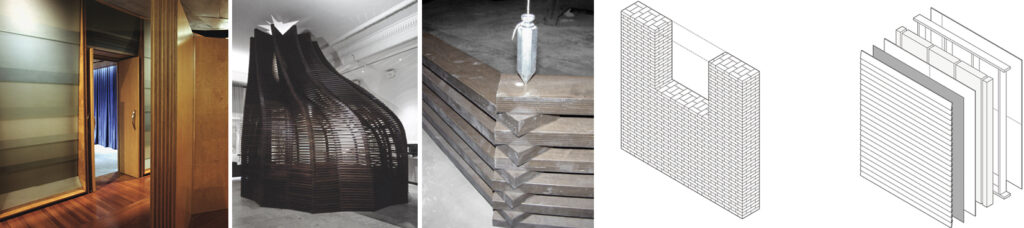
In the latter half of the twentieth century, when postmodernism offered even greater latitude to play with history, its planning remained relatively untransformed. While the construction systems that underpinned these buildings rarely played a role in their planning, they had a significant role in allowing varied iconographies to be tested on them, as overlays. Indeed, much of this generation of building was enveloped by Sheetrock and other laminar systems that were the result of late twentieth-century standardization: vapor barriers, sheathing, waterproofing membranes, plywood. From a labor perspective, what is significant about this laminar regime is that each layer is conventionally installed by a different trade, a factor that locks the architect into a conundrum. Indeed, architects are not so much free to use the sixteen divisions of construction as they are confined by them—victims of the budgets, schedules, and interfaces between each trade, all of which are locked in a bureaucratic embrace. This predicament, while challenging, is also the root of a distinct opportunity in the engagement of mass timber: how to overcome the laminar regime, eliminate reliance on redundant trades, and design with the idea of irreducibility in mind.

The Tectonic Image and the Emergence of the Rainscreen
The fidelity of correspondence between formal, material, and performative aspects is at the core of nineteenth-century buildings, but also applies to many of their twentieth-century equivalents. This has to do with the unique claim that tectonics relies on both facts and fictions: the idea that skins not only protect the building from the elements, but also illustrate it in their representation.
In a second chapter of this laminar history, we witness a more illuminating threshold, where spatial organization, material specification, and building technology performance finally become divorced from each other in the invention of the rain-screen system. Here, the outer sheathing of the building can maintain an indifferent relationship to its laminar infrastructure beneath. As a porous skin, it is finally free from the responsibilities and liabilities of performance, serving only to protect the waterproofing membrane from ultraviolet rays. Ironically, even with newly emergent monolithic systems such as CLT, this laminar infrastructure is a core requirement, which demonstrates, yet again, that the discipline of architecture might be driven by a commitment to the linguistic framework that serves its syntactic and semantic mission rather than to the structure that supports the building. Even with this newfound freedom, the building system is still entrapped by the laminar logic that characterizes so many buildings of the late twentieth century.
The Confluence of Figure and Field
Scaling up is one of the most challenging aspects of the mono-medium ethic, if only because building projects involve multiple constituencies, voices, and users. Building systems, in all their complexity, rarely allow for the kind of monocular focus on one medium possible in smaller projects or installations. Still, there are those unique moments where a single strategy can demonstrate its might. Naturally, the forces of urbanism can also affect the ways in which material propositions are deployed; and indeed they should, as it is the vitality of the city that brings relevance to the role of buildings. But if the material unit informs the configurational possibilities of a design, it is the result of thinking bottom-up, where the scale of bricks, stones, or logs reinforces the power of architectural organizations de facto. In contrast, the city has the converse power to inform the figures of architecture top-down. The negotiation between bottom-up and top-down thinking brings forward key analogies for material thinking.
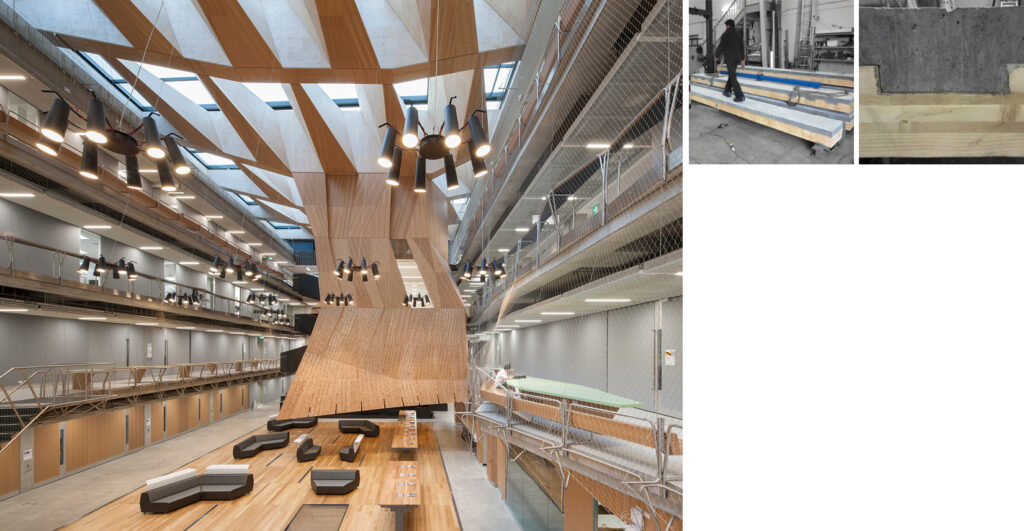
As we embarked on the Melbourne School of Design (MSD) project, we discovered an urbanism on the University of Melbourne campus befitting a broader discussion relative to architecture. With a deep and wide plot of land, our most economical strategy was the creation of an internal urban room in conversation with the urban rooms of the campus, conjuring in our minds precedents with powerful material triggers: Bramante’s Tempietto, Louis Kahn’s Yale Center for British Art, and Frank Gehry’s DZ Bank, all of which share a spatial trope paired with an attitude toward material organization that is significant in the context of this essay. All are composed as urban rooms within which a totemic object has a rarefied role. The Tempietto draws on the varied fabric that surrounds it to establish its difference. Gehry’s entrapped zoomorphic figure, however different in imagery, works in a similar way; Gehry designs his own backdrop, an uncharacteristically sober grid of windows that simulates urban conditions. In the Center for British Art, the placement of a staircase effectively produces its monumentality, further enhanced by a monolithic concrete drum. We also see how Kahn tried to incorporate the drum back into the tectonic logic of the building’s concrete structural frame, to bring them into cohesion, building a direct rapport between the figure and its ground. While this interpretation is not supported by all details, it is an alibi that we adopted for the design of the MSD atrium, whose roof structure has an intentionally direct material relationship with the suspended studio within.
The project effects a particular transformation of the building’s material units to build up the atrium. Structure and skin—timber members and plywood—work together in conspiring to eradicate the evident differences between the roof overhead and the monolith suspended below. The metamorphic transformation of wood is presented as seamless, blurring boundaries of structure and skin and imbuing functionalities to all surfaces (structural, acoustic, or programmatic). But the sum effect of building this rapport is to produce what I will call a “tectonic grain”: the ability of an assembly of parts to define a precise language, a syntax, and a lexicon that is legible. The grain is neither natural nor incontestable, but rather the artifice through which an architecture is developed, and in this instance it deals with the ability to read a deep structural system transforming incrementally onto the skin of a suspended studio, eventually becoming razor-thin as it levitates over the commons. While many architectures address the challenge of the figure, and many the field, few are able to address both at once: the tectonic grain enables a figure to emerge from the field itself.
The Tectonic Grain
As with geological strata, wood grain, or the flight pattern of a flock of birds, the tectonic grain involves a meaningful relationship between the part and whole of an edifice. Since it does not emerge from nature, the challenge is to build up that grain through exercises of patterning, aggregations, or assembly protocols of field conditions. It is also an ethic, artificial as it may be, that prescribes the limits of figuration as it relates to a rule set. The tectonic grain requires a catalytic detail as the basis for the development of an architecture. Here the detail is neither unique nor isolated, but rather the instrument through which an entire grammar may be unleashed. The grain thus defines the malleability of a proposition.
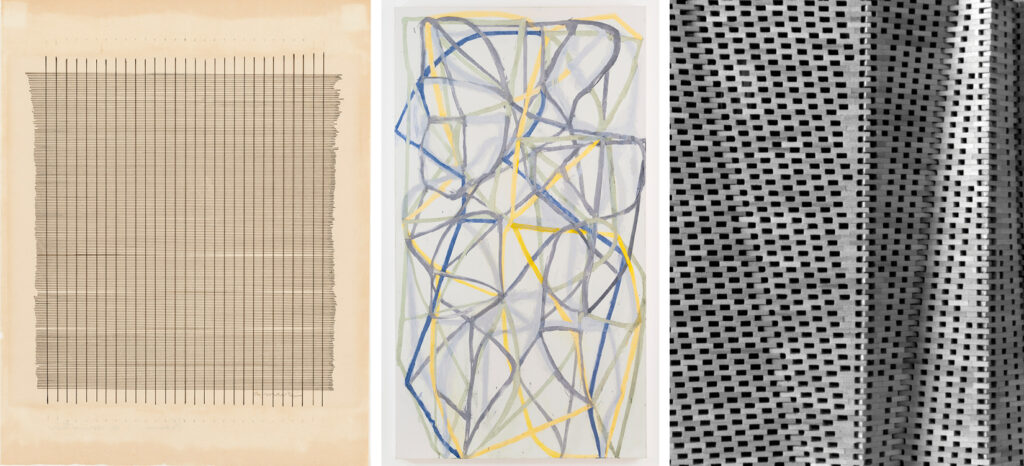
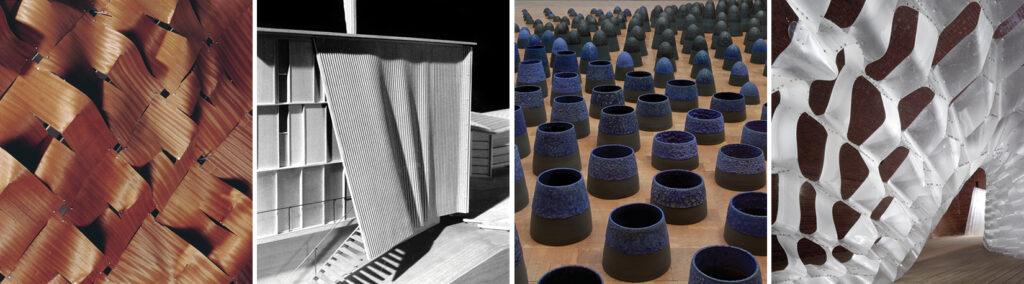
Consider the works of Agnes Martin and Brice Marden, artists whose canonical works are defined by a set of strict operations: striping for the former, and weaving for the latter. The patterns are discernible, yet Martin’s are more readily accessible; Marden’s require a deeper reading to draw out aperiodic conditions of recursion. Accordingly, even the most conventional of architectural assembly systems involve an innate grain, through which one may interpret variations. For instance, if one investigated the mortar-line dimension of a brick wall for its variability, one would come to the understanding that the running bond and Flemish bond, though different in appearance, are genetically identical. Casa La Roca is a demonstration of this principle, which also enables the figuration of the laterally stabilized curtain wall.
In some instances, the tectonic grain emerges from the manufacturing process itself and defines the limits of formal operations. Consider corrugated metal and its predisposition to bend on one axis while becoming even stronger on the other. The Weston House wall illustrates this tendency, but also reveals the connection between the geometry and grain: that the corrugation is a manifestation of a ruled surface. Herein lies an important aspect of architectural representation. Where other forms of drawings may “illustrate” a phenomenon, the architectural representation is fabricated, and therefore has an innate relationship to its construction.
The idea of the tectonic grain is furthered in the Rock Creek House, where the house’s directionality is reinforced by stacked plywood running north–south, working between the masonry structural and wood skins to amplify a planimetric logic. This orientation reinforces the direction of the brick structural walls, but also achieves two key objectives for the house: the plywood’s thinness allows light to pass from south to north, illuminating the interior, and its face-grain allows for the concealment of the home’s private areas behind planar panels, conceived not as doors but abstract sliding walls. The thin, planar aesthetic of plywood is called on to achieve mass and solidity through stacking; butcher-block technology mediates between mass-timber strategies and thin millwork techniques. Working with digital technologies allowed for the incorporation of all infrastructure, from light switches to heat sensors, into the layout without undue added costs.
Tectonic Hybridity
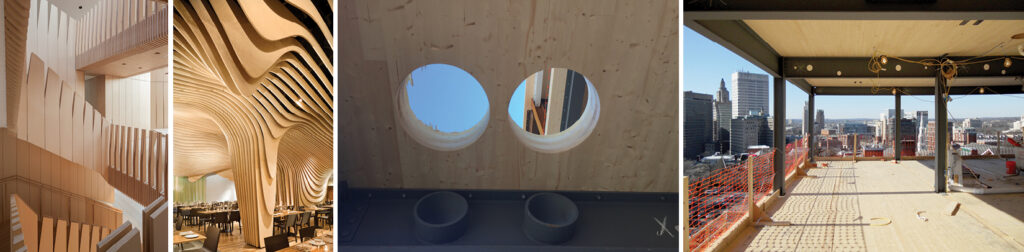
Behind the mono-material sensibility is an assumed ethic of purity, and the difficulties that underlie realizing it are taken up as badges of honor when overcome. Yet it is not uncommon that the assumed simplicity of single-minded decisions leads to complications. Thus, despite my own conceptual underpinnings, or maybe precisely because of them, the idea of hybridity has become an innate part of the tectonic riddles we face. For instance, in the context of mass timber construction, one might assume that an all-wood assembly would simplify its deployment, not to mention enhance its visual purity. But without the consideration of mechanical systems, such assumptions are immediately voided of value, since it is precisely these systems’ incorporation that challenges the architectural agenda. If anything, most CLT structures that are supported by wood columns and beams also require at least one added foot of height per floor, making them difficult to resolve in buildings with strict height restrictions. Wood beams cannot be penetrated easily, so the systems must be channeled under the beams. In contrast, the hybrid steel-CLT combination internalizes this challenge as part of its equation, a priori, revealing that its alleged impurity is, in fact, more strategically conceptualized.
At the Rhode Island School of Design’s North Hall—designed and completed in less than eighteen months—working with cross-laminated timber seemed to be a powerful mechanism to produce consensus in response to the client’s desire that the building embody an ethic of sustainability. In part, the beauty of CLT systems is that they do not require added finishes; while the floor slabs would be covered to mitigate acoustic transmission, the ceilings could remain bare, exposing the grain of the members. The main predicament emerged from the lateral spans of the building, requiring structure, both columns and beams, framing a double-loaded corridor. Certainly, this could have been done in wood, tapping into laminated veneer lumber technologies, for example, but such an approach would lead to the problems outlined above. The use of steel facilitated both the penetrations and the depth of beam, allowing for an added floor to accommodate the program. As a hybrid system, steel and CLT better advanced the overall conceptual premise better than timber alone.
The Critical Evacuation of Trades
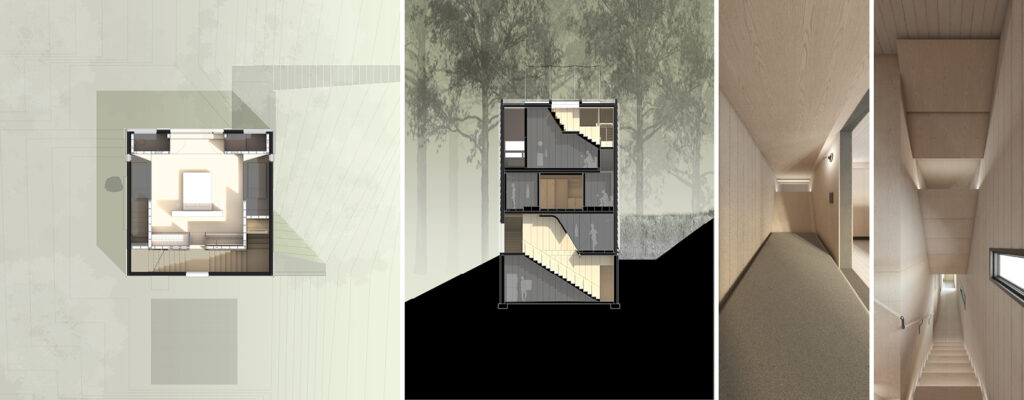
In the Poché House, we discovered an opportunity to explore this hybridity in the organization of an entire building. The design responds to the diverse ways a house may be reformatted based on seasons, economies, and urgencies; in effect, it challenges the primacy of the detached single-family home while also working within its genre. It is thus a typological study of how a single device enables varied possibilities: here, a single staircase that winds around the periphery of a four-story structure, where three bedrooms and a living area with the same footprint are stacked. The arrangement of the stair on each floor distinguishes the rooms and allows for slightly different uses. Each bedroom is designed as an efficiency, including a kitchenette, a double bed, closets, and a divided bathroom, with added space for bunk beds or ancillary bays in which seating can be situated in support of the room, all within the poché.
Every inch of space is programmed in the thick wall between the room and the external skin beyond the stair. The exterior wall is composed of prefabricated CLT panels; the inner wall is conceived of as a balloon frame to create space for the infrastructure of the house, including mechanical, electrical, and plumbing systems, as well as acoustic insulation. If the outer wall accommodates structural, environmental, and waterproofing necessities, it is also a load-bearing slab whose core is well-suited for other infrastructure; for this reason, the hollow wall of the interior is its twin sister, vacuous with reason, if only to hold concealed systems that are not commonly thought through in a synthetic way. By thinking of them together and organically, we are able to optimize lengths of ducts, the stacking of plumbing, and the efficiencies that are critical to a stick-framed house.
A Manifesto in Progress
To return momentarily to the mono-material ethic, there is a seductive allure to the idea that one might entirely conceive of a project in cross-laminated timber. First, as a pure panelized system, CLT’s industrially scaled process of assembly gives even small-scale projects the advantage of quick erection, optimal in both the kit of parts and the time dedicated to assembly. It can benefit from off-site and prefabrication technologies, allowing for lower tolerances, greater craft, and the short-circuiting of on-site complexities. Second, as a load-bearing panel, CLT offers its own innate thermal mass, which in combination with an insular layer can form a composite panel whose effective function becomes the integration of structural, environmental, and cladding systems. Third, the sectional composition of CLT produces a seductive finish that, in its own manner, can be construed as complete upon erection. Fourth, the perpendicular cross-lamination of CLT’s inner core is suggestive of other ways its particular section may be expressed, especially for structural adaptations where the depth of a panel is not required in a uniform fashion. Finally, all this can contribute to the elimination of extraneous labor and, consequently, unnecessary costs. Should this sound like a financial alibi, it is instead a form of intellectual value engineering, in service of exploring the irreducible aspects of an architecture released from excess. And yet I hope that the appeal to a more complex reading of tectonics, drawing from varied building systems, in both their technical and semantic persuasions, has been able to demonstrate that an approach that embraces the contradictions of layered systems may ultimately yield a more persuasive set of architectural opportunities. Lest this be interpreted as acquiescence, I suggest it is more an appeal to strategic thinking, a critical evaluation of hybrid systems, and a tactical approach toward contradictions and anomalies within construction narratives.
And indeed, despite all the appeals to problem-solving, it is maybe this interpretation of tectonics that complicates, and enriches, the argument posed by these construction systems. Whether used in pure or hybrid formations, these construction methods exhibit a consistent ambiguity between the facts of construction and the manner of their expression. The gap between those facts and the apparent narratives on the surfaces of these buildings is a testament to the core ambivalence that tectonics engenders: truth is not necessarily delivered top-down, but often rendered from the negotiation and mediation of contradictory parts; elements that in other narratives may appear marginal become the main plot, expanding our conception of truth in tectonics.