
MACHADO & SILVETTI: A SELECTIVE BIOGRAPHY
Introduction by Nader Tehrani
Interpreting architecture is a sufficiently complex task, but reading into a work that has so deeply biased one’s own education, practice, and pedagogy is altogether another challenge. Such is the Oedipal anxiety I confront in returning to the work of Machado and Silvetti. Yet after a hiatus of many years, the ideas that have been born out of this work seem more relevant than ever. Thus, rather than claim neutrality here, I want to acknowledge a motivated project, even if I bring to it a different cultural backdrop, generational perspective, and personal viewpoint. Suffice it to say that while this book contains a vast retrospective of their designs, it by no means completes their story. If much remains for them to build on, there is even more that others, like myself, will be contributing to their project through our own speculations.
Different in character and pedagogical approach, Rodolfo Machado and Jorge Silvetti come together in a robust and complementary collaboration. I have worked with both individually and enjoyed the experience immensely; however, working alongside the two of them is to see their potential transported to yet another level. This introduction will attempt to bring light to some of the thinking behind this partnership and speak to the buildings through which these ideas have taken form.
BEGINNINGS IN BUENOS AIRES
The delicate trajectory of individuals is often marked by important historical contingencies—and within them, key personal decisions set the stage for their formation. Machado and Silvetti were educated at the University of Buenos Aires amidst the political upheaval of 1960s Argentina and the suffocating effects of a sequence of military governments. In the university setting, the intellectual and pedagogical milieu was rooted in the by then well-formed canon of modernism– in particular, the work, thinking, and architectural legacy of Le Corbusier after his historical visits to South America. At the same time, certain ideological fissures had opened up channels of dissent that were to challenge both the political landscape of the country and its architectural trajectory. The young architects of Team 10 had already revisited modernism in a critical light, the dissolution of CIAM in Otterlo had been sealed, and the international reach of AD Magazine had begun to craft an end to modernism’s orthodoxies. Machado and Silvetti found their voices in this turmoil, gaining access to readings and expressions of alternative sensibilities.
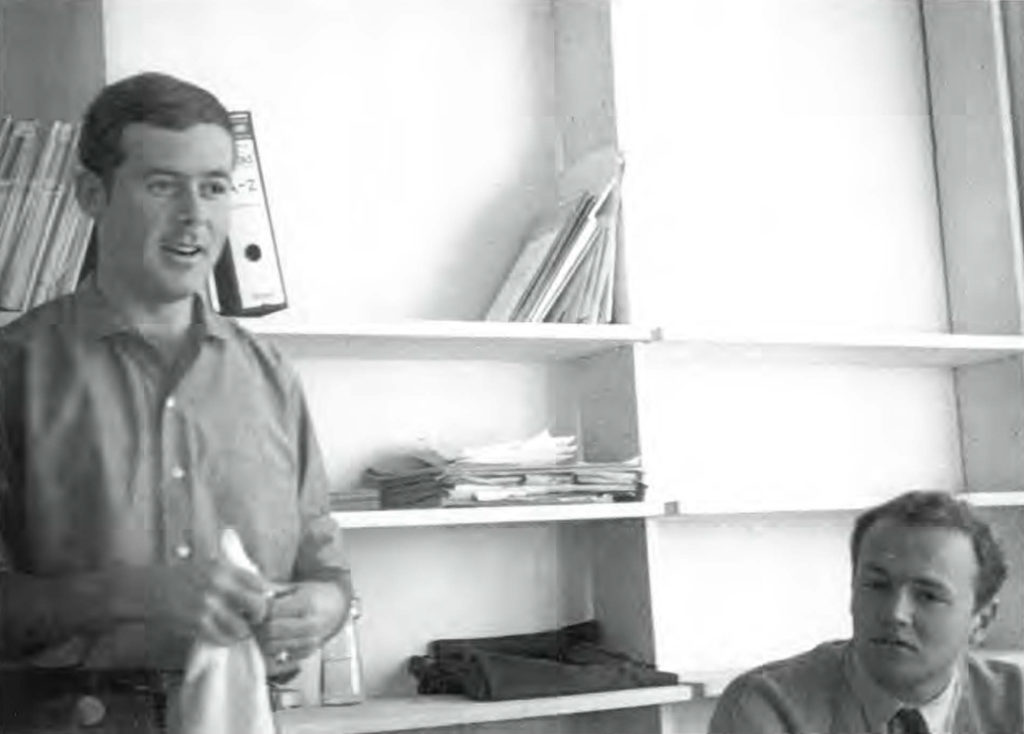
Above: Rodolfo Machado (standing) and Jorge Silvetti in 1965 at their office/studio in Bueno Aires. Still students, they formed the group of Arquitectos Asociados with four other classmates (Miguel Baudizzone, Cacho Korn, Jorge Lestard and Tito Varas) and two of their teachers (Tony Diaz del Bo and Jorge Erbin), to work on competitions, small commissions and to establish a forum for discussions of current critical ideas in architecture and urbanism.
One important source, parallel to the university, was the Instituto Torcuato di Tella, a place dedicated to the advancement of Argentine culture, where much of the cultural avant-garde hosted music, theater, and art events, among them “happenings.” [1] By the late 1960s, its freedoms curtailed by the military junta and its finances under strain, the power of its platform had been diminished. Still, as the battles raged in the streets with rocks and stones, so, too, did they in the halls of education—with Marx and Barthes, on the one hand, and pop and conceptual art, on the other. The eventual victims were similar in nature: Argentina’s desaparecidos, who were never to be seen again, and those who preceded them, leaving for far-off lands in the hopes of an alternative future.
CONCURRENT COUNTERCULTURES: PARIS AND BERKELEY
In 1967, Machado and Silvetti decided to extend their studies outside Argentina. A respite from the prevailing conditions in Buenos Aires, it was also as an opportunity for them to engage in the intellectual cultures they had inherited informally in their undergraduate studies. By 1968, with Machado at the Centre de Recherche d’Urbanisme in Paris and Silvetti at the University of California, Berkeley, they found themselves in different cities roiled by parallel strains of civil unrest: Paris amidst the labor strikes and student protests against the western Ancien Régime represented by the Gaullist government and Berkeley in the throes of protests against the war in Vietnam and the advocacy for free speech, women’s rights, and the sexual revolution.
Underlying these movements on separate continents, of course, were the intellectual threads that would lead to a new way of looking at architecture as a discipline. In Paris, Machado would, under the tutelage of Barthes and the Structuralists, develop the foundations of architecture as a language, translating concepts such as the arbitrary relationship between the signifier and signified into terms that enable architectural form to produce new types of meaning. Meanwhile, in the United States, with the development of disciplinary specialization in the postwar period, the core of architectural studies had been influenced by theoretical speculations from the outside, especially from the ranks of positivism. With the advance of scientific thought, tenets of sociology and behavioral sciences were being cast onto the architectural discipline in the guise of architectural legitimation. The collateral consequences were, in effect, an intellectual retreat from a discussion of architecture’s central cultural disciplines—whether formal, organizational, or symbolic.
This was to be a transformative period for Machado and Silvetti, as they continued a dialogue across continents that proved as charged as their environments. With telephone connections still unreliable, it was through letters (the text) that both their intellectual and personal relationship continued to evolve. Following the riots in the summer of 1968, Machado departed Paris for Berkeley as his studies came to a closure.
When Machado arrived in Berkeley he brought to the architecture program structuralist theories that were then mostly the provenance of the department of comparative literature. Meanwhile, Silvetti was still immersed in Christopher Alexander’s influential concept of a “pattern language”—in many ways diametrically opposed to the intellectual importations of Machado. Together, however, they began to shape a theoretical path forward. It was in this context that the readings of Barthes and other structuralists were to gain a kind of momentum in architecture, challenging not only certain cultural mythologies at work, but also interpreting and translating their theoretical premises from literary terms to what was called architectural language.
SETTING THEORETICAL FOUNDATIONS: A NEW PEDAGOGICAL HOME ON THE EAST COAST
After their completion of the Berkeley program in the early 1970s, offers to teach at Carnegie Mellon University launched both Machado and Silvetti into academic careers that would be decades in the making. But it was the subsequent offers from Harvard University [2] and the Rhode Island School of Design [3]—for Silvetti and Machado, respectively—that set in motion a more defining trajectory. These academic positions emerged as critical platforms for architectural speculation, leading to the intellectual transformation of their schools and challenging the architectural discourse of the time. In the 1970s, their focus was not the construction of buildings, but the construction of their architectural thinking, with key writings and design projects that would set the terms of the debate in paradigmatic ways.
At the time, questions about the nature of the architectural object and its relation to the city were being reassessed, bracketed by Robert Venturi’s “Complexity and Contradiction in Architecture” of 1966 and Colin Rowe’s “Collage City” of 1978. The Institute of Architecture and Urban Studies stood at the center of many of these emerging debates. With Peter Eisenman at the helm, the IAUS drew in a good many international voices, Aldo Rossi being one of the more influential. His “Architecture of the City” of 1966 had contributed significantly to a larger discussion about typology already set in motion by Giulio Carlo Argan, but also elaborated and debated by others such as Joseph Ryckwert, Alan Colquhoun, and Rafael Moneo. Still, Machado and Silvetti stood apart from the broader intellectual clique that had coalesced around the New York Five and the centers of power these architects defined: Cornell, Princeton, and Yale. This autonomy helped to define them, as much as it stigmatized them as outsiders. Their work at Harvard and RISD was thus central to their role in the larger discourse not only because of the impact it would have in New York and abroad, but also because, in those days, both Harvard and RISD were ostensibly weak institutions. Harvard was moving the last of the post-Sert administrators into retirement, but had not yet established a strong institutional voice. RISD, while a robust school of art, was still mired in a relatively provincial and inward-looking period, without a presence beyond its own borders.
At this moment in time, the presence of history was being cast onto the contemporary scene. At stake, in particular, was how its forms, meanings, and vocabulary could expand the terrain on which architecture was being practiced. For Machado and Silvetti, this work took on two different areas of inquiry. First, Silvetti focused on establishing the medium within which architecture operates, later evidenced in his article “On Realism in Architecture.”[4] In the cultural vacuum of the day, dominated by sterile corporate architecture, the appeal to typology was that tool, he argued, because it offered a figural frame within which conventions of spatial organization could be transformed. This was both an extension of and a challenge to established arguments by Venturi (an iconographic reading of type) and Rossi (a more conceptual, abstract interpretation of type in the context of the city). Central to this claim was the notion that types come with recognizable features and attributes—elements that establish meaningful relationships between the parts and the whole, and that are, moreover, modified by contextual conditions. Perhaps more important, adding to Rossi’s dictum that typologies are indifferent to function, which they endorsed, Machado and Silvetti pushed the idea that typologies are also indifferent to iconographic definition, thus liberating design methodologies of their traditional straightjackets [5]. By extension, they redefined typology with the counterintuitive proposition that “types” are indeed dynamic, fluid, and evolving entities, and thus much more open to manipulation, transformation, and reinvention.
In 1972 Silvetti was invited to a symposium at Princeton organized by Diana Agrest and attended by several other important protagonists, including Manfredo Tafuri. For this occasion, Silvetti prepared what was to be his first public lecture—five years later turned into an article for Oppositions, the critical journal of the IAUS that brought so many emerging voices into prominence. In “The Beauty of Shadows” Silvetti expanded on the nuances between the uses of references, on the one hand, and their critique, on the other: moments where the systemic transformation of architectural language leads to invention and a frontal assault on conventions—what he termed “criticism from within.” [6] The idea that architectural form could contain a framework for its own criticism through the production of meaning was completely unheard of; thus, it unleashed a whole arena of discursive debate on the status of forms, organizations, and the language they can produce through a process of elaboration. Implicitly, as an extension of this argument, the agency of representation was central to the idea of criticism from within: the idea that beyond buildings, the site of critique within architecture is within the medium of its conception—in drawings, models, and instruments of representation. The Djerba House by Silvetti and the Country House by Machado both eloquently testified to how types carry a deeply encoded DNA that can transform into radically different architectural inventions.
Among the myriad writings on typology of this period, the significance of Machado and Silvetti’s contributions lay in the idea that architecture is a cultural practice, and therefore immersed in systems of representation and engagement with a larger public. As such, while they adopted types as a convention for establishing continuity, they did not idealize them. Types, for them, did not have the authority of propriety, but instead were cultural matter as mutable as they were meaningful in their ability to transmit change. In this regard, Machado and Silvetti’s work also explicitly challenged the avant-garde notion of the “new,” which is invariably and repeatedly absorbed, consumed, and normalized in the digestions of the cultural process.
In the context of the city, the idea of type took on a vaster agency. If Rowe resuscitated the historical figures of urbanism through the mechanism of collage, this very technique in the work of Machado and Silvetti became a vehicle not merely for the surreal overlay of concurrent systems (both classical and modern), but further, for the strategic deployment of blended types and systemic elements within the city. Such is the proposal of the Steps of Providence of 1978. The various adaptations of the staircase as an element within Providence connect the city’s fragmented parts through strategic and opportunistic planning. But, drawing from cultural clues found in the history of the site, they also imbue each set of steps with a rhetorical stance that gives its space a specific identity. A seminal project of its time, the Steps of Providence would underline the role of urbanism across the work of Machado and Silvetti at large.
Thus, with the production of meaning as a central theme of architectural discussion and the city as its site, Machado and Silvetti redefined the instruments of the debate. With the resuscitation of history after the modern movement, not only was the status of its forms and meanings at stake, but more so, they were now open to appropriation, alteration, and reinvention. While in the hands of others, history was to emerge as a mechanism for legitimation, Machado and Silvetti continued to take apart the forms of history analytically—this, as a basis for a critical encounter with their transformation. They cast the “real” of architecture, then, as the very foundations from which architecture’s particularity could be identified: its conventions, typologies, and accrued meanings, but also its materials, modes of assembly, and construction techniques. In other words, the real of architecture was defined from within its own history, theory, and medium. In turn, the very strategies for adopting conventions would set the terms of how its language could be turned into an instrument of compliance, commentary, or criticism.
ADVANCING THE CONCEPTUAL PROJECT: FROM REALISM TO THE UNPRECEDENTED
The 1980s saw both Machado and Silvetti well ensconced in their academic practices, with their respective institutions, RISD and Harvard, soon playing deeper roles on a stage much larger than the East Coast. It was also a period when they would formulate their most far-reaching theories of architectural production, operations gathered within the term “unprecedented realism”. In 1980, for the first Venice Architecture Biennale, whose formative theme was “The Presence of the Past,” Machado and Silvetti prepared an entry for exhibition that would articulate their position in relation to the instrumentalization of history. Their entry was actually a single plate that presented a range of ideas, projects, and buildings, a collage of sorts, graphically coordinated to become one synthetic image. What was remarkable about this image, however, was that beyond its graphic reconciliation, it pointed to the way in which architectural space, iconography, and differences could be brought into new forms of alignment, such that there emerged the possibility of inventive and unprecedented juxtapositions. As a drawing, it escaped the traditional closure that is conventionally aligned with architectural drawings, and the self-conscious overlays of projections underlines the critical potential of drawing as a medium. The associated text clarified their critique of the avant-garde, but also sidestepped the trap of a focus on style as the basis for architectural transformation. Although the biennale had many progressive ambitions, somehow the dominance of historical legitimation and the re-invocation of classicism as its means proved the victor of the moment. In contrast, certain themes stood out in the work of Machado and Silvetti that set the path for their research to come. Chief was a shift in focus to what they called “emerging typologies”—buildings and organizations that registered the new programs and culturally relevant types of the time. Further, in the consequent hybridization the reassembly of these typologies was an attempt to develop unprecedented spatial configurations that could reflect present urgencies.
Many proposals arose from this period, from the D.O.M. Headquarters to the Times Square Tower, from the project for the City of Este to the master plan for Carnegie Mellon University. At an architectural scale, they share the struggle to bring divergent types into reconcilable coherence, suggesting a shift from techniques of collage to montage, where the emphasis lays less on the objectification of differences among architectural parts than on a new and inventive fusion between opposing realities. In the Este Tower, for instance, the loggia, basilica, and garden maintain a relative benignancy when viewed as parts, but conspire to something fundamentally radical when reassembled on top of each other. As an exquisite corpse, the project also suggests a figurality that releases multiple readings, adopting ambiguity as a positive incentive for architectural elaboration. This reinforces the notion that while an arbitrary relationship exists between form and content, there are still cultural and social underpinnings for architecture as a discipline. Architecture is used, it is experienced, it is interpreted and yet none of this can assure a common reception. Still, the interpolation of this audience somehow establishes an ethical dimension in the work of Machado and Silvetti. For this reason, the production of meaning is one way to speak to the public, and figuration but one device for capturing the cultural dimension that comes with public agency. The instrumentality of figuration also suggests references and allegorical forms that might tap into cultural iconography in ways that escape—or supersede—the strictly disciplinary channels of architecture.
With an eye on figuration as a significant theoretical tool in the work of Machado and Silvetti, it is important here to differentiate between the figures of types and figuration adopted as an artistic practice. In the context of typology, the basilica, rotunda, and stoa all contain certain irreducible traits. Their mere mention without images can conjure up a tally of attributes that constitute the relationship among their parts. They each come with recognizable shapes, forms, and spaces, such that any alterations can also subsequently be read against a convention or a principle of averages. From this, the transformation of types elicits rhetorical flourishes: exaggeration, ellipses, metaphors, or other such manipulations of easily identifiable architectural orders. Outside of the architectural limits of forms, though, are shared boundaries with sculpture, painting, and other arts, all of which have had a conspicuous role in building up the architectural repertoire of operations. The architecture parlante of the eighteenth century spoke to the often ambiguous and shared territories of sculpture and architecture in the context of figuration. Ledoux, Lequeu, and Ribart each in his own way teased out the potentials of this fusing, suggesting the defamiliarized long before surrealism arrived as a movement. To look at Ribart’s cross section of L’Elephant Triomphal, however, is to recognize that the figurative impulse far exceeds the shaping of objects and the insinuation of jokes; the spatial, hydrological, and structural implications of this drawing elicit a far graver encounter with the disciplines that give rise to architecture.
Machado and Silvetti’s proposals for the Taberna Ancipitis Formae Architectorum Machadus Silvettusque Mirabile Inventio MCMLXXXIII folly from 1983 and the Tower of Leonforte from 1986 operate with similar, if not even more profound, disciplinary implications. Whether invoking the abstracted body of St. Sebastian or the Janusian crania of colossi, the projects are generated by such a deadpan tectonic discipline—the first looks to the tufa stone structures of Sicily and the second to centuries-old brick and terra cotta aggregation—that each can be channeled primarily through the medium of construction. The folly proposes a deliberate layering of tectonic overtones, blending Miesian precision with the Roman orders. Both projects investigate walls, arches, thresholds, and assemblies for their latent ability to break free of normative associations and functions. Likewise, since neither project was built –or maybe precisely because– the site of invention remains within the space of representation; yet both projects unleash some of the most potent and memorable drawings, not only as tools for description, but as vehicles to rethink how we see the world. The folly, drawn in crisp ink lines, adopts a straight tone of description, a technique that could allow them to smuggle in the surreal with the mastery of architectural subterfuge. For Leonforte, the clinical delineation of the city in accordance to conical projections becomes a way to rediscover what is actually an ancient city. Its monuments, squares, fountains among other icons are lovingly framed as part of a vertical narrative of the Leonforte Tower, with each telescope becoming the architectural materialization of the agency of representation. In both projects, the tectonic realism of their associated models –and their subsequent photography– emerge as eerie reminders of a world that could be, or even maybe one that has already existed; the real and unreal are overlaid without one’s ability to disentangle. Also in both projects, the construction of perspective is manipulated such that it denaturalizes not only how we draw, but how we build subjectivity. Their perspectives draw the viewer into the depth of the spaces being depicted, only to discover that the drawing is speaking back. Much like the inverted perspectives of the FM House and Cranbrook gateway, perspective is adopted as an artifice to overturn reality as we know it. With the folly, the narrative of sensuality more deeply reinforces its cultural role, both as a historical artifact and as a physical environment for the body. Though a purely conceptual project developed for an exhibition, it remains a tour de force even today, and its distant cousin materialized in the 1990s in New York City’s Wagner Park.[7] At the southernmost tip of Manhattan, a city of giant structures, the framing of the view to the Statue of Liberty invokes the submerged figure of a colossal ruin, replete with the masonry orders that have brought the folly to life. (Nader, how about a reference to the Entry Pavilion of the Getty Villa as another more distant re-incarnation? R and I saw this particular element of the Villa as directly coming from the Taberna.
In the urban context, Machado and Silvetti’s submission to the 1990 competition for the Piazza Dante in Genoa achieved much of the infrastructural ambitions of the Steps of Providence, but with a figurative charge. Its main stair establishes a relationship with the very nautical structures once navigated by Christopher Columbus, whose house still stands next to the piazza—again arbitrary, but completely motivated. While the innate connection between ships and architecture is also well documented, here figuration operates in a more allusive way, signaling something much larger: the discovery of the new world, the deep history of the place, and the many associations that each conjure. In all instances, the role of the figure is at once recognizable, yet estranged. Like the Trojan Horse, a metaphor borrowed from Silvetti himself, figuration works first to seduce, then to enter with the ferocity of an avant-garde attack.
Much of this thinking emerged from a studio on emerging typologies that Machado had prepared for Rice University in 1983 the focus of which was to engage in building and urban configurations for which there were no clear precedents or established conventions. The actual term unprecedented realism entered into the lexicon of the practice with a studio he conducted at RISD. Yet it was clearly the result of a family of shared operations within Machado and Silvetti’s collaboration. As a theoretical tool, unprecedented realism also formed a critical claim to numerous projects outside of the practice, as it sent roots into the diverse pedagogical platforms engaged at the time. The Este Tower, for instance, belonged to a larger urban design submission for the Venice Biennale of 1984, and thus a host of students cultivated its ambitions. In his studio text, Machado referred to the techniques of collage and surrealism, but also clarified how the medium of architecture finds its ammunition in tectonics. While seeking to create an “alternative reality”—and “critique of reality”—he invited the studio to look outside of the architectural discipline, but also he emphasized the need for “architecturalization,” as if to translate figuration back into a relevant medium.[8]
FROM THE BODY TO CONFIGURATIVE PRACTICES
The seeds that were planted in the era of unprecedented realism led Machado and Silvetti to projects of greater complexity—projects that could not tolerate the simplicity of the architectural act, but required urbanistic sensibilities and a commensurate scale. Within the idea of emerging typologies, the Carnegie Mellon University competition of 1987 proved to be a turning point in the practice. The sheer quantities of program, the diversity of functions, and the dimension of the site necessitated a theory of production that could generate the kind of complexity more often developed in cities naturally over a long period of time. The Carnegie Mellon campus also offered certain contextual triggers that could enable an organizational matrix from which to work: a fabric, as it were. From this emerged not so much a figure as a series of figures that together form a configuration of parts, akin to a woven madras. Historically aligned with large structures that exceeded their architectural scale, such as El Escorial in San Lorenzo, the Palace of Diocletian in Split, or the Albergo dei Poveri in Sicily, the Carnegie Mellon project develops hierarchies of spaces—cubicles, rooms, and halls, corridors, alleys, and streets, pavilions, buildings and megastructures—the sum of which weaves the campus back together through an array of typologically distinct morphologies. The results are sober in their recognition of the complexity of a campus. But the proposal also stages a collateral benefit that situates buildings and spaces in unprecedented relationships, fostering the possibility of programmatic exchange, overlay, and synthesis. It is the exquisite corpse on the x, y, and z axes, a veritable mat building whose spatial and semantic range far exceeds that of such antecedents as the Berlin Free University or the Venice Hospital. In the hands of Machado and Silvetti, the mat becomes the rich three-dimensional matrix that characterizes the layered city.
This focus on the configurative spanned forward into other proposals, like the Houston Sesquicentennial Park of 1989 and the Vienna Nordbahnhofgelände of 1991; each developed urban frameworks from which variation and contextual deformations were derived in strategic ways. These projects also marked Machado’s transition in 1986 from RISD’s architecture program to Harvard’s urban design department. At Harvard, Machado set the stage for a broader investment in urbanism in general, but also in pedagogies that were reflective of urban landscapes without precedents. The Porta Meridionale project of 1987, proposed for Palermo, would be the most iconic outcome. At this time, Machado and Silvetti together proposed a series of urban design studios that would greatly influence their work ahead. Their two “Urbanities” studios challenged the very idea of urbanism in an age when cities no longer develop organically, but require techniques that instantly produce the conditions of complexity and reality—this as an antidote to the mall, theme environments, and other such sterile urbanisms of the day. Side by side with this research, they led a number of studios on Sicily, extending a long-held fascination with the ancient island and the Mediterranean at large, born of a deep cultural affinity with their respective ancestry in Spain and Italy. Sicily, whose many layers of history produced extraordinary unprecedented realities, also offered the perfect site on which to invent a set of design problems that would straddle the relationships among archaeology, architecture, and modernity.
As the economy began to expand in the 1990s, so, too, did the scale and size of the firm’s commissions. The traditional relationship between buildings, blocks, and urbanisms would become more ambiguous. With megablock developments, the idea of the mat was no longer the exception but the rule, and yet few had theorized it with a sense of rigor. As Machado and Silvetti’s work gained a certain popular momentum, other researchers such Stan Allen and Hashim Sarkis, would begin further to investigate the mat within a historical perspective, taking on this theme with an urgency to extend its theoretical framework. For Machado and Silvetti, meanwhile, the tension between figurative and configurative practices grew as the projects within the office increased in volume and they faced the reality of professional engagement, not only in the sphere of architecture, but also in that of urban design.
BUILDING PRACTICES: FIGURES AND FIELDS
The transformation of Machado and Silvetti as a firm into a building practice produced a meaningful shift from their academic work. With a small set of commissions in the 1980s and early 1990s behind them, winning the Getty Villa competition and embarking on the design of its expansion in 1994 enlarged the office tenfold. It also required the partners to translate their conceptual and theoretical priorities for a broader cohort[9]. Their baggage of professional experiences would catapult them into new possibilities for materializing complex assemblies, in some instances; but it would also be a sober reminder of how the industry predetermines the vast set of questions and specifications that go into building processes. Balancing out the relationship between the customized and the generic, the theoretical premises of the figural and the configurative helped Machado and Silvetti to set certain priorities within each project. If the configurative was the more vocal, the discreet development of figures also matured into yet a third stance: the elaboration of figures through abstraction. What may be harder to capture in the built projects is the thematic consistency of their earlier history—primarily, because the circumstances of commissions have required more pliancy and protean versatility. As such, the built work would bring to light a wider range of the theoretical repertoire.
In the built work, the presence of history would still loom large. But this history was viewed through an expansive lens that captured the cultural and social context that drives form. With the Getty project in Malibu, Machado and Silvetti took charge of an architectural figure so powerful—a replica of an ancient villa in Herculanum—that the only way into the project was to invent a narrative that could give substance to J. Paul Getty’s initial folly. At once absurd theater and entirely serious, the campus plan had to both give credence to the notion that the villa had a reason for being there, but also establish another distinctive and invented architectural language in support of it. What evolved from this narrative was the fiction of an archeological site, whose frame of reference would be the villa itself. The entire infrastructure of parking, entry pavilions, study centers, and numerous supporting elements, then, would configure a larger urban formation around the villa to provide its context, both physical and historical. In turn, the language of the new buildings could be reinforced along archeological lines, exposing architectural and geological strata. The new buildings maintain a deferential relationship to the Getty Villa without the obvious strategies of mimesis, emulation, or mirroring; they stand their ground by constructing a new ground from which the villa emerges. The architectural figure and the urban configuration around it play a symbiotic role. While aptly this operation forbids the architects from erecting a singular icon of importance for the campus, what transpires is the possibility of configuring an iconic framework that gives veracity to the original folly.
The Getty project coincided with Silvetti’s ascent in 1995 to the chairmanship of Harvard’s Department of Architecture, a position that he had essentially been rehearsing over the years as one of the leading figures to reform the curriculum and its various programs. Now, however, he had a veritable platform for his ideas, connecting design with history and broadening the conversation to include disciplines often left out of the dialogue, among them archaeology, industrial design, and theater performance—all cultural spheres that have arguably had a deep impact on architecture. Perhaps the most important pedagogical shift he undertook was to develop the course “Buildings, Texts, and Contexts.” The course, which he in part taught, brought historians and designers together to present case studies from different ideological perspectives, elucidating the sometimes challenging relationship between form and the sociopolitical framework from which it is derived, or that it sometimes effects.[10] This dynamic between history and practice thus took on a like urgency within Machado and Silvetti’s own projects.
For instance, with a similar focus on history, the extension of the Chazen Museum at the University of Wisconsin-Madison, begun in 2006, adopted a different stance. Academic in their study, Machado and Silvetti clinically analyzed the original building by Harry Weese as a prerequisite for their own extension. Many canonical strategies exist for such architectural additions; among the most obvious are the opposing positions taken up by Scarpa and by Venturi, Scott Brown in their respective interventions at Castelvecchio and the Sainsbury Wing. For Castelvecchio, Scarpa clearly identified the differences between the old and the new by juxtaposing two languages as much as two material, spatial, and formal orders. In contrast, Venturi and Scott Brown worked deviously with the classical language of the National Gallery to graft onto it—extending it through a more literal emulation of its orders, while at the same time distorting it and giving it rhetorical flourishes.
The Chazen Museum reveals a more challenging strategy of grafting an extension onto the original: it expands the DNA of the existing building, but also, in the process, invents a new set of spatial, formal, and surficial transformations that speak to difference in a deliberate yet subtle manner. Chameleonic in its approach (recalling the Trojan Horse techniques of unprecedented realism), the scheme evolves from an existing centralized plan that is effectively Palladian in its biaxial symmetry, an artifact onto which it is virtually impossible to add. And yet, despite all apparent conventions, Machado and Silvetti reflect the upper volume onto the east side, seamlessly connecting the two phases by way of a bridge. In effect, by mirroring the existing building, they invert the figure-ground relationship, which gives prominence to the space in between rather than to the buildings themselves. Ingeniously, this creates an urban threshold that links the city to the lake beyond and turns a museum that was once an autonomous object into an engaged piece of urbanism.
If this might suggest an inattention to the building, nothing could less true. The deft configurative crafting of the building’s façade is central to this ruse. By aligning the stone coursing of the new to old wing, the long horizontal span of the elevation gives the civic front the space to metamorphose over its length. The elevation transforms incrementally, from smooth to rusticated to a fluted condition. Unlike its classical antecedents, the fluting is arranged horizontally, denying it of conventional overtones. Instead, it emphasizes the sheer modernity of proportions in the horizontal extension of this mat building aloft. Naturally, the aggregation of stone is very much a configurative act and thus lends itself to the sly evolution of masonry architectural conditions. The reading of the fluted figure viewed from the “western edge,” then, is nothing other than a radical discovery, as if a colossal order had been laid on its side—at once nominally discernible and yet completely defamiliarized.
Of course, the preoccupation with tectonic configuration is inherent to many construction practices, with masonry playing only a part of that rich history. And yet the allusive figures that might be discovered within—or better, drawn out—are uniquely characteristic of the Machado and Silvetti sensibility. Consider the masonry-bonding layout of Citadel Square in Beirut, a project to integrate a densely layered archaeological site adjacent to the harbor into the new public square. A new stone retaining wall effectively seals the ruins of the medieval castle behind a finished face that captures and indexes its arches and thresholds, among other features. Mapped directly over diverse architectural parts, this cohesive layer both conserves the ruins and uses its configurative tectonic logic to give rise to monumental figures contained within. The citadel appears as a ghostly apparition, embossed with the presence of history and yet evidencing an extraordinary digital logic that only contemporary tools could produce with precision. Though Machado and Silvetti are not particularly known for their expertise in computational work, this project makes a case that architectural agency trumps the digital, or otherwise gives it purpose. Of course, Citadel Square is a further instance of their deep cultivation of a relationship with the Mediterranean—the geographical entity that has more than anywhere else defined the ethos of city- and nation-states on its periphery—and, beyond architecture, the longue durée of its history and cultural traditions.
CONFIGURATIONS OF TECTONIC SCALING
If the stone unit used for the construction of Citadel Square is singular in dimension, it also produces a monolithic seamlessness that deliberately refuses scalar variation. By contrast, Machado and Silvetti’s residential projects reveal an equally deliberate play with scale that gives a rich intricacy to the configurative process. The dormitories for Wiess College at Rice University, the University of Rome, and Princeton University as well as the housing complex on Tenerife all display certain consistencies with respect to scaling. Each of these projects concurrently registers the tectonic block (brick, stone, precast), the fenestration block (window, door, threshold), the spatial block (bedroom, bathroom, living areas), and the building block (wing, tower, mass), allowing for interpretations of greater complexity. Each in its own way establishes a strong connection between the spatial order of the interiors and the expression of the building on its façades, effectively pulling alternative orders from the confluence of scales. For instance, the figural diagonal striping of the residential development on Tenerife is the direct result of the negotiated planning of spaces, materials aggregation, and massing potentials of the block. A similar argument can be made for the folded face of Scully Hall at Princeton, where each bay operates at the scale of the room, while each folded rib operates at the scale of the precast unit. Thus the logics of these layered systems uncover figures that, in turn, instantiate a larger architectural ambition about the environments they serve, whether symbolically or urbanistically.
Of all Machado and Silvetti’s housing projects, the most beleaguered by fierce public scrutiny was their graduate student apartments for Harvard University, a structure generated by these very same principles. Begun in 1999, One Western Avenue descends directly from emerging typologies. It is a recombination of a series of blocks, a bar (composed as a bridge), and a tower—but brought into a linguistic alignment that smooths over their evident differences. The university mandated that the entire complex work as a single building, such that a person could navigate from any one part to any other part through its interiors, thus in many ways contradicting the potential urbanistic strength of its organization. Recognizing its precarious relation to the high-speed intersection of Storrow Drive, the complex is arguably scaled ambiguously to be seen at fifty miles per hour, while also intimating the scale of the pedestrian from the core of its courtyard. The inner court offers one of Machado and Silvetti’s most inventive civic spaces to date, framed by a colossal lintel in the form of three stories of dormitory rooms that capture a view of the Charles River.
Nonetheless, the building’s organization has fallen victim to the necessities of an internalized plan that precisely divorces interior from exterior and thus encumbers the mediation of scaling found in the other housing projects. Here the skin takes on a larger task than normally required, without the intermediary scales of rooms or balconies. As a composition of fused blocks, the skin, too, draws alignments and patterns that speak to the figure-ground relationships of wall and window. In the case of the bridge, this tectonics of the block takes on a more atmospheric organization, vein-like and stranded, as if fused with the clouds above. It is, in fact, at the scale of the skyline that this building is most vividly present, speaking to Sert’s towers across the river and to downtown Boston beyond.
If the Harvard housing displays an unapologetic encounter with its patronage, it also shows the power of abstraction in the urban landscape. Both the massing and skin of the building synthesize what is irreducible about the project in its context. The overt figuration of building types may be silenced, yet the bold urban relationships they generate cannot conceal the strength of the figural by-product. The icon plays a secondary role to that of the urban void, and yet ironically it is precisely the building’s identity that has become the butt of popular critique.
The result of a negotiated collective planning process, the Harvard project is a perfect example of democratic protocols gone awry—whereby discrete and incremental decisions made by opposing parties in the community disengaged the figural ambitions of the project from its configurative ethics. Interestingly, Machado and Silvetti developed Atelier 505 in Boston, a mix of residences, retail, theaters, and art spaces, during the same period and under similar pressures of a community process; in this case, a developer-driven initiative. Though a singular building, the structure is divided into four distinct organizations, each responding to its own context, as if to mirror irreconcilable external conditions. Each building part takes on a different character and its own organization. But counter to the emerging types of the era of unprecedented realism, Machado and Silvetti made no attempt to bring the various compositional elements into new syntactic relationships, leaving the building to fend for itself at each face. The building has been a popular success, even if it has not gained the same support in disciplinary circles. This perhaps points to a fundamental schism that emerged in the late twentieth century between the design discipline as an autonomous practice and the impending pressures to design by democracy, in which all voices are considered equal even if coming from a perspective that has less access to the building’s performance and disciplines.
THE ABSTRACT FIGURE, CONFIGURED
Work on the Harvard housing coincided with a juncture in Machado and Silvetti’s academic life. Silvetti began to wind down his leadership of the architecture program at Harvard, exiting as chair in 2002, just as Machado stepped up to chair the Department of Urban Design in 2004, giving a renewed sense of priorities to their intellectual mission. It is important to stress here that while Machado and Silvetti operate as a productive duo, they also maintain critical differences. Thus their respective imprint on projects varies, yet the totality of the work acquires its richness precisely because of this tension. The sheer volume of projects in the 1990s and early 2000s required a more organized separation of their leadership within the practice, with each contributing to the other’s projects more surgically than in the collaborative mix of the early years. Sidestepping the inevitable reductiveness of the assertion, one could venture that each has a distinct stake in figuration and configuration. For instance, Silvetti’s encounter with configurative practices has leaned toward the tailored fragmentation or deformation of plans (and their subsequent detailing), while Machado brings a bias toward the reduction of parts and a more brutalist approach to form. Still, their sensibilities and priorities inform each other’s projects, as is evident in the skin of Harvard, where Silvetti takes a lead, or the massing and planning strategies of Princeton, where Machado is more vocal. The alliance between urbanism and brutalist materiality may also be no accident, as Machado’s attempt to draw certain core values to the surface. If this seems like a retreat from iconography and a search into fundamentals, it is done with the assurance that Silvetti will deliver the other concerns to the table.
Another series of projects—the Bowdoin Museum, the Wellin Museum, and the NYU Global Center—evidence Machado and Silvetti’s curatorial command over the architectural figure. In the Bowdoin College Museum of Art addition, completed in 2007, a relatively small entry pavilion is required to play a figural role as prominent as the very structure it supports, the Walker Art Building by McKim, Mead and White. It does so by positioning itself correctly in the “context” of American campuses, an object in the landscape of quads. Yet in discrete ways, the unique hydrological orientation of its roof helps to achieve two contradictory goals. First is to maintain the abstraction of the cube, in deference to the original museum, which is crowned by a prominent dome; second is to use the figure of its own roof to “point” back at the dome, as seen through the diaphanous veil of the glazed pavilion. Hydrology, semantics, and abstraction come into a kind of devious alignment of circumstances, providing for an iconic yet allusive symbol that, at the same time, performs its technical duties with incisive precision.
The Wellin Museum at Hamilton College, completed in 2012, can be seen as an extension of the abstractions of the Harvard project. With few urbanistic clues from which to draw in rural Clinton, New York, the building is left to construct its context from within as much as in response to the campus. As such, the cantilevered volume that extends symmetrically over the entry passage serves as both lintel and threshold into the building, but also as an abstract variant of the very two bars that uphold it. In no way emphatic about its figure as a “keystone,” its mere position in relation to two like entities encodes its motivations. Despite its retreat from figuration, the deepened portal speaks directly to another such volume on axis with it in the Hamilton Theater and Studio Arts Building. In a technique central to Machado’s repertoire, the two entrances and their corresponding buildings bracket the space between, giving it figure, if only abstractly.
The Global Center for Academic and Spiritual Life at New York University, also completed in 2012, came with a programmatic disposition that offered few opportunities for elaboration outside of the zoning restrictions, which, once breached, enabled a commanding proportion for the building. The center sits on the southern side of Washington Square Park, framed by its triumphal arch to the north and located on axis with Fifth Avenue. Thus while the project’s internal planning might be relatively benign, its prominent public presence stood as a responsibility. The Global Center desired an identity that could, in one uttering, speak to various faith groups, be they Muslim, Christian, Jewish, or other denominations—an impossible request if taken literally. Machado and Silvetti drew from the various books of faith and philosophy the metaphor of the tree of life, which resonates with a wide range of cultures, while also offering a space for architectural speculation. The massing of the building remains without significant figure. But the skin derives a configurative logic from an abstraction of the tree, overcoming its overt representational nature by embedding it in architectural scenarios that avoid mimesis. Much like a classical building, the stone veneer is fashioned as a gradient skin that maintains a solidity and massive presence on the lower levels, while dissolving into a light and thin surface on the upper levels. So, too, the anomalous conditions of entry, public rooms, and varying faith offer a respite from the repetition of patterning, allowing a robust sense of a building in tension with the very representational system that gives it its distinction.
All three buildings behave with a deep sense of their environments, but never acquiesce to them; instead, they construct the context through the figures that define them. Even when somewhat divorced from the configurative logics of their architectural organizations, these projects use the power of autonomy as a motivating contextual force.
THE URBAN CONFIGURATION AS FIGURE
By comparison, yet another family of projects either adopt the urban context to give form to their architecture or, alternatively, build an urbanism within their architecture such that the city extends through its very organization. Completed in 2009 and 2012 respectively, the Olayan School of Business at the American University in Beirut and the Black Family Visual Arts Center at Dartmouth College demonstrate Machado and Silvetti’s preoccupation with urbanism in diverse ways. Academic buildings on prominent sites at the edges of their campuses, both bring the urban life of the campus into new territories. The business school frames the university playing fields in conjunction with the recreation center by Vincent James, anchoring the north side of the campus along the Mediterranean. Extending an existing promenade from Bliss Street on the hilltop to the Corniche at the bottom, the siting gives the campus a new face onto the sea. Olayan plays into this logic by acknowledging two grounds: first, the ground off the Corniche, which provides access to parking, and second, a new artificial ground that is grafted to the natural terrain of the sloped hill. Distributed along a row of prominent piloti are all the key public programs—café, conference rooms, and various auditoria. At this public level, the Venturi effect, (no relation to Robert), accelerates the mild sea breezes through to the back courtyard. All of these programs are enclosed in glazing, whose transparency maximizes the views to the sea. The building thus serves as an environmental threshold, a gateway into the campus, and an immersive space that is both indoor and outdoor, without resorting to any overt gestures of monumentality. The piloti blend in with the logic of the trees and naturalize the program within the context of the bosque; in essence, the building interprets the terrain and surrounding flora as the basis for giving form to a new seafront.
At Dartmouth, Machado and Silvetti’s task was far different. Sited at the eastern edge of the college, the Visual Arts Center uses its building fabric to invert the backside of the campus into a new front. New Hampshire’s subzero temperatures suggested another way to organize a program composed of many departments; with two promenades running east-west and north-south, the building is conceived as a city, though one that is interiorized. Each department is thus set within its own block, like an urban parcel out of which space is carved. In turn, the central atrium functions as a plaza, a place where all the arts come together in a civic realm. A veritable mat configuration, this building reinvents the city around it.
While iconic in their presence, both projects resist the temptation to become spectacles. They bring focus to the infrastructural nature of their organizational make up, adopting their identity from the filigree of their circulation. If the ultimate manifestation of their identity is found in their elevational figures, then the diaphanous skin of Beirut also emerges from the environment of the Mediterranean, just as the monolithic rusted slate that clads the Dartmouth building belongs to the Northeast. The warm yellow blocks of the business school are laid out in a varied Flemish bond, configured as a civic garden wall, framing the natural landscape and inviting the building to breathe. The arts center, on the other hand, punctuates apertures between rugged slate, in syncopations that defy the unity of a single building and offer instead rhythms that build up the very pattern of the city.
THE PRESENCE OF MACHADO AND SILVETTI
It is maybe only with age that one gets to witness the cyclical nature of certain debates, ideas being recycled, and old arguments being reworked. We are witnessing one of those moments now, and within it a reminder of the relevance of the work of Machado and Silvetti. Consider the more recent obsession with performance, ecological systems, or multi-disciplinary collaborations, all areas of concern that are arguably serious, earnest and legitimate. However maybe more poignantly, behind some of these new tendencies lies the innocence of a desire for the technical legitimation, especially in those instances where design is supplanted for the yearning of positivist determinism. If the economy and professional technocracy has not mandated this, then it has become the new calling for a new generation of architects, all aligned with a new form of “professionalism”, even those within the academy. Against all this rests a series of thoughts, writings and works by Machado and Silvetti that are soberly at ease with their priorities; understanding fully well where the agency of architectural design may lie, they have made no apologies for design as a discipline. Where generations have repented for their iconographic sins, they have instead invested in a theory of production that is as critical today as it was thirty years ago—all this while maintaining a Hippocratic Oath to the very ethical aspects that build layered reasoning into buildings. Their buildings respond to the myriad of concurrent contradictory technical functions that all great projects of integration require, and yet much of this is allowed to rest dormant so that the project of synthesis may find a voice through the spatiality, materiality and organization of architecture itself. Their ability to balance out their biases with a commitment to architecture in its heterogeneous agencies has allowed them to side-step myopic ideological bickering so evident in the platforms of debate today.
As Machado and Silvetti now prepare for the next phase of their practice, they can look back on their many years of academic and practical experience with a real sense of perspective, locating themselves within the larger trajectory of the discipline, and furthermore, within the debates that changed the course of history within that trajectory. In the context of unprecedented realism—which I still hold to be one of their major contributions to the discipline—comes a sense that no single thesis can contain the wealth of ideas they have brought to fruition. For this reason, my introduction has attempted to corral a very diverse set of built and unbuilt projects around certain figurative and configurative techniques. Not only have these devices framed their own work, but they have also deeply influenced other practices and platforms of thinking between academia and the profession. At the same time, unprecedented realism holds a larger argument within which the figural and configurative impulses have gained intellectual shape, so I have specifically invoked this theme as an important lens through which to view the arc of their work. As with all ideas, they are subject to cultural absorption, appropriation, and consumption. Both Machado and Silvetti acknowledge that the potency of unprecedented realism has perhaps waned in the advance of global media, as advertising, television, and the Internet have become stronger platforms for cultural messages than anything the architectural discipline can deliver. And yet, within the delineations of what architecture can actually do, within its techniques, I suspect that their work exemplifies some of the critical thinking that only this thesis could have launched.
If the reality—and brutality—of commissions has changed the way in which the couple works, it has also forced a profound sense of curatorial and strategic choices among certain extremes within the broad compass of architecture: on the one side, the infrastructural arena of urbanism, planning, and organization, and on the other, the sheer power of the symbol, the surface, and the icon.
That no single technique binds the imagery of these projects is indicative of the broad authorship of the collaborations. For over four decades, Rodolfo Machado and Jorge Silvetti have not been cultivating a style. Rather, they have been working with the configurative mechanisms of materials, organizations, and assembly logics, trusting that the disciplinary protocols of architectural composition could lead each project toward its ultimate figure. At the same time, I would hold them far less innocent of the processes of figuration. In tandem with the deep investment in the discreet incremental acts of aggregation, their control over the semantic content and formal dispositions of the architectural figure is informed by a broader investment in cultural icons that emerge from social practices and rituals. If their architecture results in a wide panorama of materials, forms, and spatial constructs, it has also allowed them to escape the tyranny of a brand, while building up the core of their work from a body of disciplines.
As with all publications, this one has taken a few years to advance, and so with that, certain critical projects have had the opportunity to see their completion, and in turn, to contribute to the body of work as an oeuvre. Of these, one stands out and deserves the last word, in part because of its poignant alignment with the themes discussed here, but also because it reveals an aspect of desire and pleasure so intrinsic to the culture of Machado Silvetti, that I have maybe neglected to underline in this introduction. Somehow, the Asian Art Study Center at the Ringling Museum of Art materializes a range of paradigmatic qualities that condense the ethos of this partnership, and bring this selective biography to synthesis. Designed as a pavilion that caps the urban peninsula of the sprawling museum, the intervention is actually set in the gardens of which it becomes a part. Beguilingly drawn as an extension of the complex, its green terra cotta glazed tiles makes clear that this iconic artifact is instead a deliberate challenge to its architecture, while effectively engaging the strange history and culture of which it becomes a new character. Set atop a public loggia, the green tiles wrap around the entire pavilion, not only reflecting the dense and tropical flora that is part of the Sarasota landscape, but also an allusive –and more abstract– nod to the ceramic tiles of the Cà d’Zan Mansion. The volumetric patterning of the façade, gives body to the massing of the pavilion, while distancing itself from any direct iconographic connection to its historical context, but instead establishes an estranged tangency – somehow an architectural materialization of magic realism. Much like Frankoma ceramics[11], the tile exudes color, but its glazing absorbs the context, reflecting it, and with that, the various colors of the landscape, the sky and architecture, which become part of its palette. In a tell-tale detail that gives rise to the morphology of the entire building, this project brings together the figure in the configurative arrangement of its tiling. Bringing emphasis to the pavilion as ‘object’, the tiling is rotated such that it produces a fringe at its lower limit where it meets the soffit of the loggia. Instead of rendering the ceiling as mere soffit, it is rather composed as a fifth facade, a space between the gardens and the lobby: though, instead of a face, a body itself, because the tiling is called on to turn the corner at its base, and to give volume to the underbelly of the figure of the pavilion. Propped up by six massive pilotis, the strangeness of this artifact aloft is as surreal as it is classical: deft in its syntactic precision, it is also deliberate in its scalelessness, oblique in its references, and plentiful in its sheer pleasure, the embodiment of “jouissance” in the architectural act.
Nader
Tehrani, 2014
[1] Instituto Torcuato di Tella was a non-profit foundation dedicated to support and promote argentine culture established in 1958. Originally devoted mostly to art events organized around the important private art collection of the Di Tella family, it became in the 1960s one of the most important promoters of advanced and avant-garde art manifestations of the times in the continent with an expansive program in the visual arts, experimental music and theater, art criticism and happenings that involved multi media events. The intensity and strengths of its programs transformed one of the most traditional and aristocratic locations in the city in “la manzana loca” (the crazy city block), which attracted daily crowds of eager youth to participate in their avant-garde activities. It begun to loose vibrancy and presence during the military dictatorship and its repressive policies of the late 1960s which resulted in a significant exodus of artists, intellectuals and professionals to European and USA destinations (both Rodolfo Machado and Jorge Silvetti left Argentina in 1967). It closed its doors in 1970.
[2] The Harvard Graduate School of Design brought Jorge Silvetti to its faculty in the Fall of 1975.
[3] The Rhode Island School of Design brought Rodolfo Machado to its faculty in 1976.
[4] “On Realism in Architecture”, Harvard Architecture Review, Spring 1980 issue.
[5] Jorge Silvetti “Four Public Squares in the City of Leonforte, Sicily,” Assemblage #1, Oct. 1986, pp 54-71.
[6] Jorge Silvetti “The Beauty of Shadows”, Oppositions #9, 1977.
[7] See “Follies: architecture for the late twentieth century”, catalogue to the exhibition at the Leo Castelli Gallery in New York and The James Corcoran Gallery in Los Angeles, 1983.
[8] For an in depth discussion of the concept of Unprecedented Realism and excerpts from Rodolfo Machado’s course syllabi on the topic, see Hays, K. Michael, editor. Unprecedented Realism: The Architecture of Machado and Silvetti, Princeton Architectural Press, New York, 1995.
[9] For more details on the competition see Marion True and Jorge Silvetti The Getty Villa, The Gety Trust, 2005, pgs 69/71 and 99/105.
[10] Buildings, texts and contexts a one year long case-based, novel course in two parts required for architecture students, consisting of twenty-four week-long in-depth case studies, each of a single building or a text (twelve per semester), taught jointly by a practicing architect and a historian. The first instructors and originators of this genre of teaching were Jorge Silvetti and Howard Burns during the Fall Semester (concerned with selected cases from Antiquity to Baroque), and Michael Hays and Wilfried Wang during the following Spring semester focusing on selected cases from the 18th Century to the present. It replaced, in 1994 the traditional surveys that had characterized architectural history teaching in the 20th century and its introduction in the GSD curriculum signals the beginning of major and fundamental transformations of the teaching of architectural history in this professional school. This required course has continued and evolved at the GSD to the present under other instructors.
[11] The couple owns an extensive collection of Frankoma ceramics, which is lovingly housed in Cape Cod, and negotiates their simultaneous love of high and low culture. Though completely cryptic and biographical, it is also indicative of the varied sources from which references emerge, beyond architecture, in theater, industrial design, decorative arts and film, to name only a few.