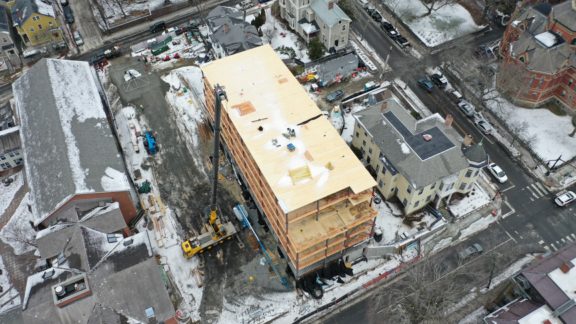
New England’s First Hybrid CLT-Steel Res Hall Structure

Posted on February 13th, 2019 by Katie Faulkner

Posted under: _RISD NORTH HALL, construction

Image above from Odeh Engineers

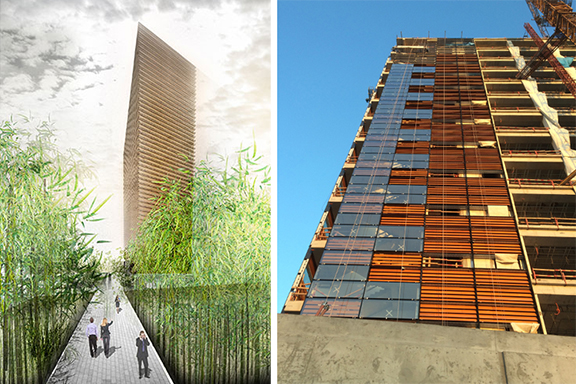
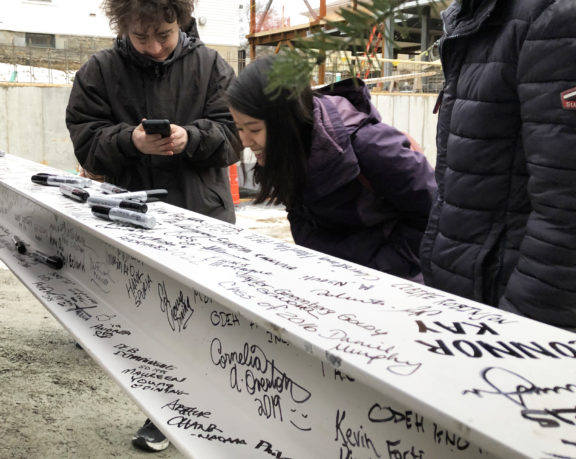
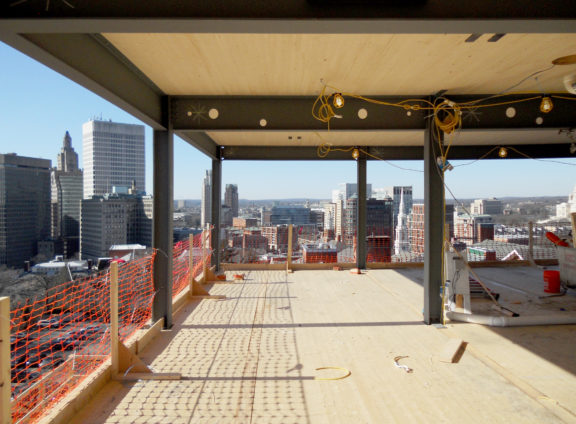
NADAAA’s new residence hall project for the Rhode Island School of Design is going up at 60 Waterman. The team celebrated the ‘topping out’ on January 23rd.  Neighbors, friends and the RISD community were invited to sign the final beam before it was hoisted to the 6th floor. In keeping with tradition, a small tree was placed on the beam.  The tree, a gesture to the Scandinavian forest spirits, will remain atop the structure until the building is enclosed. After a string of freezing cold days, the building was resplendent during the ceremony, its golden cross-laminated timber (CLT) deck glowing in a steel frame. More than one person commented that it was a shame that the building could not remain that way.
Most architects are acutely aware of the paradox that in trying to build our best civilization we are among the planet’s greatest producers of waste. Construction garbage accounts for a disturbing percentage of the world’s refuse.  Hence the excitement around the potential of CLT construction.  Made of plies of kiln-dried soft-woods, CLT is poised to make a significant impact to the market in the near term.  It can be cut to size in a factory, shipped, and installed without modification. The biggest financial challenge to using CLT tends to be logistics (e.g. how far is the job from the production facility), and with new plants coming online every few months, that may cease to be a problem.
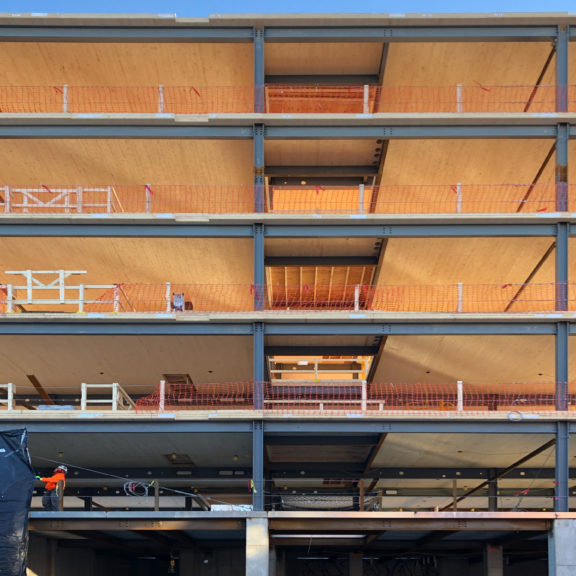
60 Waterman was designed to take advantage of CLT’s dimensional stability and a maximum truck bed size. Five-ply planks were driven from Canada, 8 feet wide and 50 feet long. Due to the relatively light weight, the manufacturer fit many planks on a truck, so there was minimal strain in getting material to the erection crew. Weighing much less than precast concrete planks, CLT is capable of greater coverage, going up faster using a smaller crane and less fussiness than precast concrete plank. The building structure was complete in less than three weeks. CLT has no camber – it is joined to adjacent planks with a spline.  If the CLT needs to be modified, it can quickly be cut with a chain saw. Try that with concrete.

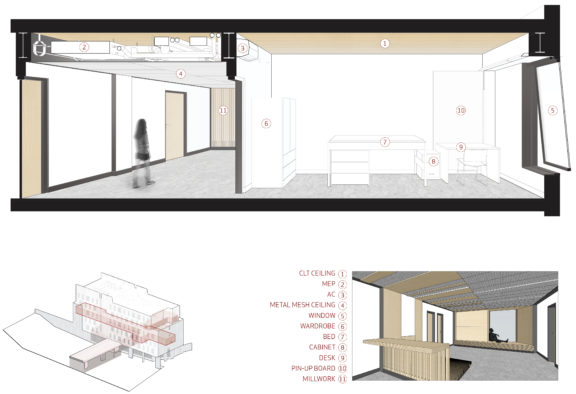
Using an Integrated Project Delivery, NADAAA worked with Shawmut Construction and subcontractors to coordinate a central utility spine in the corridors. Mechanical feeds and sidewall sprinklers afford maximum ceiling height and flexibility of layout for the bedrooms. Perhaps the most exciting thing about 60 Waterman’s design is the warmth that wood ceilings will bring to the building interior.  That simple gesture is the byproduct of a design process driven to optimize construction time, budget control, and minimize material waste.
Along with the construction partners, NADAAA collaborated closely with structural engineer Odeh Engineers, Inc. to evaluate numerous options for the superstructure. The team ultimately chose the hybrid CLT system due to its inherent sustainability, beauty, and speed of construction. When this building opens in late August, it will be the first hybrid steel-CLT residence hall in New England, although likely not the last.
Comments Off on New England’s First Hybrid CLT-Steel Res Hall Structure
‘ENTRELAC’ RECYCLED INTO BLANKETS FOR SYRIAN REFUGEES

Posted on January 31st, 2017 by Katie Faulkner

Posted under: Installations + Exhibitions, Things We Like

entrelac blanket_576

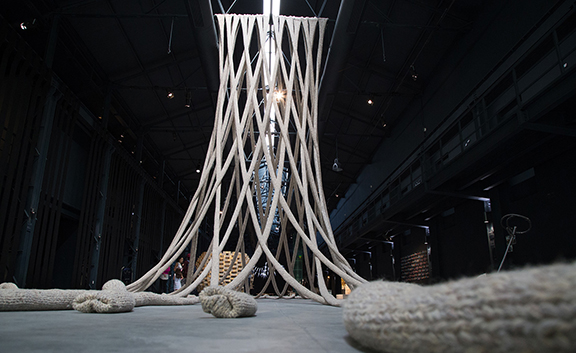
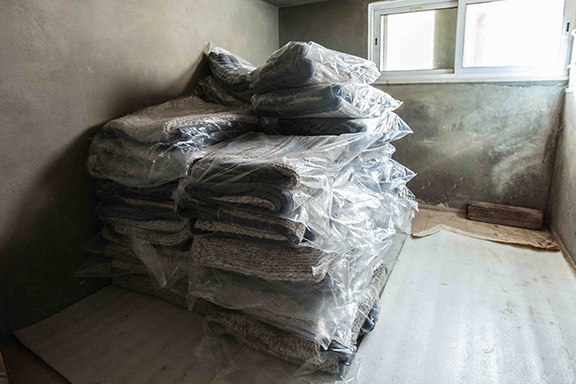
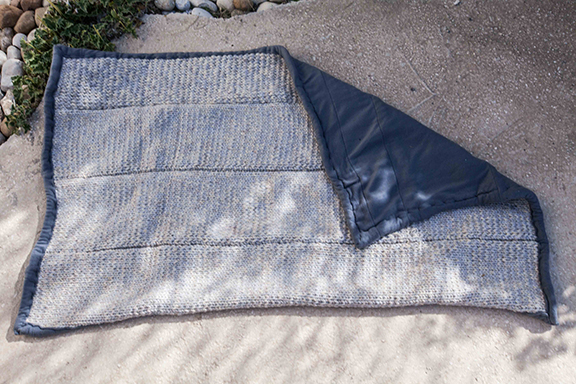
With support from NADAAA, Raya Kassisieh and the Amman Design Week team took the initiative to recycle “Entrelac”, cutting and stitching it into blankets that were later distributed to Syrian refugees and Jordanian families.  The original installation, included in the week-long event during September 2016,  consisted of 300 kg of un-dyed wool, hand knit and hung from the roof structure of Amman’s Electric Hangar. The design team utilized computational modeling to determine an approximation of the knit fabric ‘structure,’ which was then hand-knit by a team of twenty Jordanian women. Grounded less in precise digital production than in hand-craft and garment-making, Entrelac was simply “scaled up” to dress its venue, slung from the the standing roof trusses, and draped gracefully onto the floor.
entrelac_wallpaper_576

ENTRELAC process 8-3

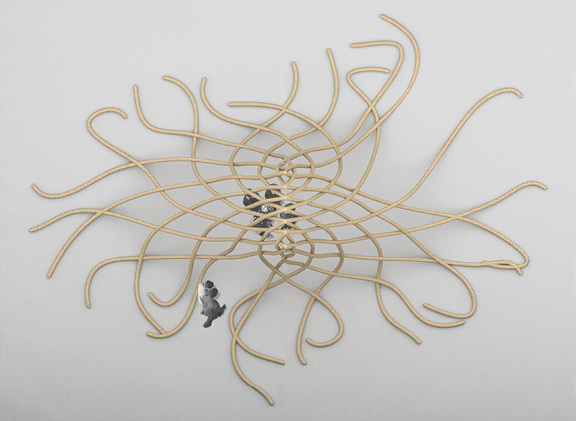
Twenty-eight large knit strands were produced, which were hung from the existing structure and again woven in a traditional Palestinian single X, at a larger scale, to form an enclosure. 
1

ENTRELAC process 6-2_WIDEN_576

The craftswomen skillfully and carefully knit each strand of the exhibit in their homes and small workshops. This network of domestically scaled production allowed for Entrelac’s rapid installation within the Electric Hangar exhibition hall. 
 

The notion of the re-purposing the installation is at once humbling and inspiring –  humbling because most of us do so little in the face of this tragedy that we are able to proceed unaffected during the quotidian replay of our lives. Yet this small act reminds us that humanity exists as a chain of relationships; someone had an idea, called some friends, momentum was built, and Amman Design Week was launched.  Someone else had an idea to weave the yarn of Entrelac into a global story that ended in a gesture of humanitarian assistance.  No more difficult than most tasks architects balance on a regular basis.

IMG_6702

IMG_6766_576 PI

Thank you to Raya, Rana, Abeer, Sahel, and all of the others at Amman Design Week who remind us what it means to be both a designer and a human being.

More photos HERE.

©2016 Amman Design Week. Photo: Hareth Tabbalat

Comments Off on ‘ENTRELAC’ RECYCLED INTO BLANKETS FOR SYRIAN REFUGEES

BOSTON’S GOT A PLAN – SORT OF

Posted on November 21st, 2016 by Katie Faulkner

Posted under: Urban Design

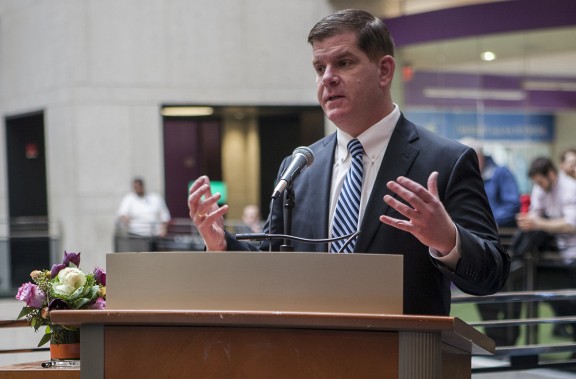
Last week was an interesting one for mavens of Boston’s housing scene. Mayor Walsh made an appearance at ABX, on the “Boston You’re Our Home” panel discussion.  Although the Mayor left the room before the Q + A, he did listen to the presentations of his fellow panelists, as well as contribute a few remarks of his own, queuing up Imagine Boston Expanding Opportunity, the City’s 2030 draft plan of priority initiatives which was released two days later (final master plan to come out next year). Kudos to whomever designed the program for this ABX session – the perspectives were different and fascinating.  In his opening remarks, Mayor Walsh reminded the room that Boston is more than halfway toward meeting its goal of 53,000 new dwelling units by year 2030. Tamara Roy, current BSA president, echoed her long-held championship of small housing units, most recently touring the city with Uhu, a 385-square foot prefabricated urban house.  Kimberly Sherman Stamler, the young and articulate president of Related-Beal, effectively communicated the complex web of partnerships required to achieve success for her firm’s mixed-use Parcel 1B. Finally, Mark Erlich (Executive Secretary-Treasurer of the Carpenter’s Local 40) tempered the festive mood with harrowing statistics of under-paid construction workers.  Something we all know, even if we do not think about it, is that the low-bid system encourages cutting labor costs (see Beth Healy and Meghan Woolhouse, September 18th Globe Spotlight article HERE).

Walsh

 PHOTO BY OLGA KHVAN FOR BOSTONMAGAZINE.COM

The takeaway was thus: Boston is building 53,000 new dwellings, and they are going to be small.  In order to “make the numbers work,” there will be city-sponsored partnerships with developers, and some percentage of the construction workers are likely to be undocumented and/or under-paid.   Thus as architects, we should understand the landscape (literally) as we contribute our part to this building boom. As Dr. Krakower said to Carmela Soprano: One thing you can never say: You haven’t been told.


Keeping it Big Around the Edges

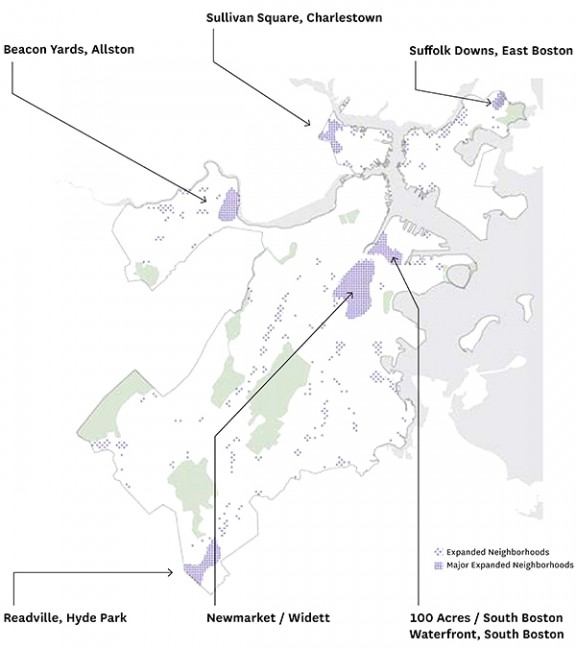
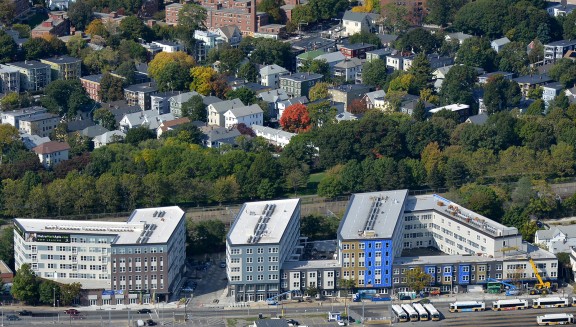
The 152-page Expanding Opportunity report is a colorful, easy read, and indicative of the trends and preferences of Boston’s housing cognoscenti. Consistent with the panel’s focus, the 2030 document is concerned with significantly increasing housing stock without sacrificing Boston’s unique urban character. The document presents much to be hopeful about: a reasonable percentage of low, moderate, and mid-level housing; healthy, walkable neighborhoods with open space and access to public transit; prioritization of good education with economic opportunity; reduction of green house gases; support for smart-city technology; and a commitment to arts and culture. Potentially troubling however is the “Expand the Neighborhoods” chapter.  Let’s face it. 53,000 is a lot of apartment, and Boston is an old city without much frontier. So in order to hit the number, you are going up or pushing out.  Given that skyscrapers are near impossible – thwarted by the FAA, geology, and general disdain for ostentation  – Boston will see more of the latter, mega-blocks at the edges of neighborhoods with hundreds of small to mid-sized rental units. A ride to Forest Hills on the Orange Line takes one by some mighty big sites. You have to wonder what Jane Jacobs would say about the bigness and sameness going up in the name of transit-oriented development.  Admittedly, these parcels were created by the kind of urban planning that put I-93 between the South End and South Boston, but simply extruding big parcels does not create the kind of density that sponsors the honorable initiatives proposed by the Mayor’s team.

edges-2

According to the Mayor’s report, “in workshops and on-line”, Boston residents agreed that the edge areas – those industrial blocks in neighborhoods like Allston, Sullivan Square, Roxbury, and Readville – are places where Boston can grown.  Of course this makes sense because no one lives there to object, and in many cases, the parcels are changing use from something like a transit depot to affordable dwellings.  If we do not want to become like San Francisco, a beautiful city where most of us could never afford to live, we have to increase the supply to meet the demand.  As someone from the Mayor’s office noted, “the units have to go somewhere.”

MetroMark-Aerial-1

The authors of the plan are doing a good job reaching the neighborhoods, and odds are strong that the 2030 plan will sponsor positive outcomes.  These are smart people who know that mixed-use development depends on the success of ground floor retail, walk-able sidewalks with civic destinations (libraries, parks, schools), with more than one primary function so that people are going outdoors on different schedules, at different times of day.  Smaller blocks facilitate mixed use because smaller businesses have a chance to participate in the mix.  If you want to see another Flour, Clover, Boomerangs, Newbury Comics, or Haley House grow its business in your neighborhood, look for smaller building footprints punctuated by cross streets.

A few months ago, in her article Boston is Getting Really Expensive, Rachel Slade called out the fact that many of us already cannot afford to live here. That creative class that I like to think I’m a part of, is seeking more-affordable towns, taking Boston’s funkier side with them: “I hope you like T. J. Maxx and Starbucks” Slade says, because all the cool people are leaving. She’s right, and the best way to solve this problem is to increase the supply of housing, accessible to multiple income levels.  And those units have to go somewhere- but perhaps not all of them need go on the same block.

lead_960

ILLUSTRATION BY JOSH COCHRAN


Comments Off on BOSTON’S GOT A PLAN – SORT OF

The Divine Lady Z – by Katherine Faulkner

Posted on April 4th, 2016 by Katie Faulkner

Posted under: Press

ZAHA-HADID

It is often in loss that we come to understand the full value of something dear to us.  Such was my discovery last week when I learned that Zaha Hadid had unexpectedly died; a fact that upon penetrating my confused fog, produced a nauseous panic.  With her sudden departure, I feel strangely rudderless, as if a small hole has been exposed to be a crater.  Looking for solace among the pantheon of powerful women architects that she leaves behind … well, they are huddled together on the head of a pin.

I did not know her personally, had never worked for her, studied under her, or even visited a single one of her completed buildings.  The worldly Baghdad-born Ms. Hadid was likely intimidating from her outset, and had I met her, I would have been overcome with awe. Her pedigree was near perfect.  Born to privilege and raised with a sterling education, Zaha Hadid entered London’s Architectural Association during a particularly dynamic moment of the 70s, studying with Rem Koolhaus and Elia Zenghelis – starting her career as their employee at OMA, arguably the most influential firm of the last thirty years.   By the time I was a student in the late 1980s, Zaha Hadid was already famous for her brazen self-confidence and her deft navigation of a male-dominated profession.  There was in fact, little in her that I could emulate, yet she was with me from the beginning. She was the only woman architect we students revered, despite that she’d had almost nothing built.   All of us called her “Zaha” as if she were among us, making jokes at her expense, while admiring her untamable talent for drawing unfathomable form and inspired compositions of dizzying force.

Zaha Hadid’s building’s challenge our conventional notions of beauty and utility. In their autonomy, they seem to completely disregard their context, although ZHA director Patrick Schumacher would likely cut me down for being obtuse.  For once that professional grumpyman would be right.  Long before parametric modeling, Ms. Hadid was expounding upon the Russian Suprematists of the 1920s, such that Malevich looked simple.  Her work was marvelous, in the most literal sense, as color, movement, and depth were conveyed with the emotion of a Bacon painting, and the rigor of perfect math. Many wrote her off as a paper architect, banishing Zaha Hadid to the world of the Russian avant-garde, John Hedjuk, Lebbeus Woods and other draftsmen whose exquisite drawings we coveted even as we knew we’d leave them behind with our childish things.   The palpable force of her work however, would not be contained to mere paper. When the Vitra Fire Station opened in the early 90s, Zaha Hadid strode loudly into that Manhattan all-male social club – the Century – invited to a table reserved only for those who both ruled the Academy and saw their work built.  Alas, poor Philip, move over.

Within hours of her death, tributes and admiration flooded the internet such that her many achievements are revisited; dozens of accolades that include “Best Dressed,” “Most Powerful,” gold metals, Stirling Prizes, and the coveted Pritzker for which she will always hold the distinction as having been the first woman to have won.  Her work transcends conventional architectural practice to film, fashion, furnishings, and set design.  A favorite rumor or fact – in 1999 Zaha designed the set for the Pet Shop Boy’s Nightlife tour. (Were she and Dusty Springfield the original West End Girls?)  Zaha was no stranger to controversy.  Neither she nor any of her team were invited to the opening of the London 2012 Olympic Aquatics Center – oversight or snub?  In 2014 she was depicted as both heartless and clueless in connection with the death of hundreds of migrant workers preparing for Qatar’s 2022 World Cup and the ZHA-designed Al-wakrah Stadium.  As recently as last month, she made headlines with her indignant refusal to cede copyright of her scrapped stadium design to organizers of the 2020 Tokyo Olympics.  In fact, the media critiqued her with scrutiny never inflicted upon her male peers.  Zaha was described as tempestuous – she dressed to be noticed; she was infinitely quotable.  Dig deep enough among her press clippings find she was a smoker – at least until recently.  She never married, had an enormous closet, loved jewelry, maintained her nails, dyed her hair, could be officious to wait staff, alternately mean and extraordinarily generous to her employees – a real diva.  Perhaps this treatment was intended to offer some logic, as if in painting her to be another Maria Callas, we could comprehend her extraordinary talent.  More likely however, critics and paparazzi-alike were fascinated by this rare bird of beauty, with a confounding ability to shape space beyond comprehension.

Reading the early postings, I am noticing pattern. “She was more than just a female architect!” her admirers proclaim, admonishing us not to remember Zaha Hadid as a great woman, but rather as a great architect.  That her legacy be protected from the inferior label of “greatest female” anything should not come as a surprise.  Whenever there is a list of most successful/powerful/influential women, at least one in the crowd will say “thanks, but I do not think of myself as a powerful woman.”  Amy Schumer becomes indignant when labeled a female comedienne (would anyone call Stephen Colbert a male comedian??), although her best material comes from the stereotypes and social norms that confine her gender.  Women want to believe they occupy the same meritocracy as men, and the women who achieve success in their male-dominated fields should be entitled to a pride in their hard work and talent. Nonetheless, whenever I hear a female colleague say she is immune to gender bias, I want to know where to get a ticket for that space shuttle – now there’s is a planet I’ve never been to. Lots of women practice in the field of architectural design – lots of women hold influential positions in schools of architecture, but very very few women ever claimed a seat at the table of the Century Club. Those seats were reserved for powerful professionals, with the ability to shape trends, shift opinion, and maintain their relevance within architectural discourse.

With her passing, Zaha Hadid gives women unanticipated (for which I’d gladly have waited decades more) gifts.  She reminds us that architecture is indeed an art; that in order to bring that art to life, one might have to sacrifice personal popularity, endure withering criticism, and expose femininity to ridicule. Zaha demonstrated that we are limited only by ourselves; that architecture’s relevance can extend far beyond conventional practice.  Above all, she exposed herself as alone on an admittedly small podium, as a singular woman among the world’s most formidable architects.  We can argue endlessly about other women, successful in their own right with bright futures, already recognized and imitated for their work.  Yet for a certain generation of architects – mine – the departure of Zaha Hadid exposes that things really are as imbalanced as they seem; that we have fallen short of the required combination of talent, endurance, and sheer bravado required for a seat at that powerful table.

image above by Nicole Sakr, adapted from a photo by the Knight Foundation

Comments Off on The Divine Lady Z – by Katherine Faulkner

New Age Old Town

Posted on April 30th, 2015 by Katie Faulkner

Posted under: Things We Like, Urban Design

Since March 1, I have read Casey Ross’ A New Age for an Old Town dozens of times.  The Boston Globe feature is interesting on a number of fronts; Mr. Ross describes our current “golden age of building” within the context of earlier waves of the 19th and 20th centuries that produced some of the city’s most beloved landmarks.  He takes us back to the 1964 construction site of the Prudential Tower, and even quotes John Hynes referring to Boston as the “Athens of America.”  The best thing about the article however, is the link to the sidebar graphic – a collection of articles chronicling 52 buildings that have either been provisionally approved or have actually started construction.  There is remarkable similarity among the images, and it is tempting to sort the buildings into piles: the plane-slippers, the wrapper-shifters, and the skirt-lifters.  In short, most are variations on the theme of maximizing a floor plate.

According to Casey Ross, and generally backed up by the BRA website, there is 34 million square feet of new building in the near-term Boston pipeline – this is Boston alone.  Imagine if we could add in Cambridge and Somerville. Within that number are other interesting stats.  At least 7 of the proposals are legitimate skyscrapers; 63% of the projects have a significant residential component, and most often the housing is paired with a hotel.  There are 29 development teams financing these projects, although there are recombinations and LLC’s that make it hard to count the players.  In a subsequent letter to the editor, architects Mark Pasnik and Michael Murphy note that Ross’ list of projects illustrates that development is an “insider’s game.”  They point out that two architecture firms are producing nearly a third of the 52 projects but stop short of revealing that Elkus Manfredi is involved with 25% of them.  In total there are about a dozen firms in the mix, with Miami’s Arquitectonica winning the “traveled the farthest” award.

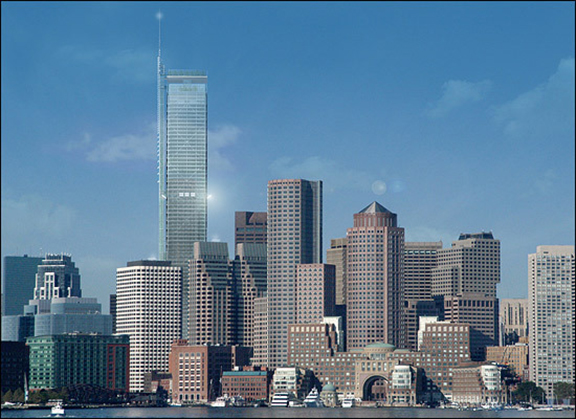
If it hasn’t happened already, the City will soon designate a development team for the Winthrop Street Garage.  Ten years ago we would have called this Trans National Place.  At that time, developer Steve Belkin had engaged Renzo Piano to design a 1,000 foot tower.  The details of that project are the stuff of legend, and the upshot is that one cannot build a super-tower so close to Logan Airport.  Nonetheless, Belkin gets points for raising the architectural bar.  The original proposal had elegant proportions and tectonic heft that somehow gave unity to the eclectic volumes of Downtown. The reincarnation of the project promises to be both shorter and less inspired, but it will nonetheless take its place on Boston’s skyline as a marker of this our 21st century “golden age of building.”

Trans National Place designed by Renzo Piano

Trans National Place designed by Renzo Piano


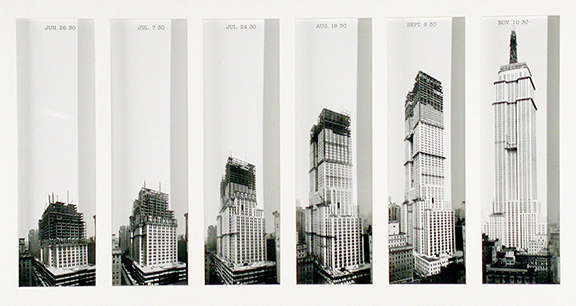
Harvard professor Edward Glaeser wrote that “(r)eally tall buildings provide something of an index of irrational exuberance,” and he points to the iconic Empire State and Chrysler Buildings as examples.  To his point, towers generally go up in economic boom times, and emerging economies continue to show their might by sponsoring increasingly stunning and tall buildings.  In contrast, Boston towers do not tend to be particularly tall, and the City seems not to see them as icons of our urban greatness, which is a shame because once it is up, a tower becomes an indelible part of our identity.  Much as we might like to erase One International Place, it’s not going anywhere.

Construction of the Empire State Building

Construction of the Empire State Building


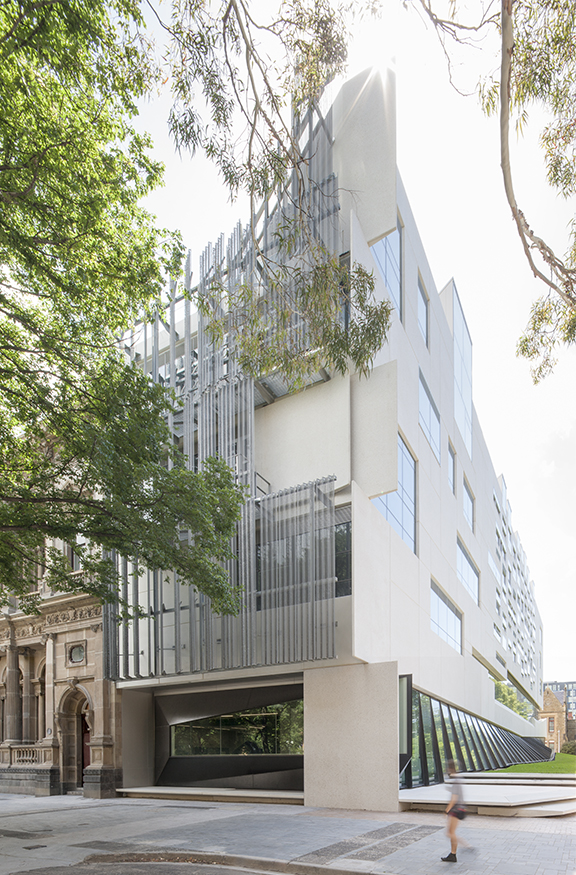
As I was penning this blog, Rachel Slade published her scathing “Why is Boston so Ugly?” piece in Boston Magazine.  This is the article many of us have wanted to write but could not articulate.  She called out the visual affront of 111 Huntington, and the lost opportunities of the Seaport District.  The conventional wisdom that it is hard to get anything built in Boston is called a bluff.  It is actually ridiculously easy to build just about anything if you know the right people.   Ms. Slade takes on the BRA and exposed the long tenure of the BCDC members.  Most endearing was that she listed NADAAA among the “most vigorous design firms,” although I did not appreciate her assessment that firms like ours lack the capacity for big buildings.  Capacity is not the issue.  Jonathan Levi Architects won the Harleston Parker medal with an 84,000 square foot public school and the firm has designed millions of square feet of institutional, residential, and educational buildings.  Anmahian Winton Architects have a high-rise under construction in Ankara.  David Hacin has mid-rise residential buildings all over town, and is in fact one of the prospective design teams for Winthrop Square.  NADAAA just completed the 250,000 square foot Melbourne School of Design, the result of an open international competition, and has larger projects in design and construction. What binds the work of these firms together is not their relatively small size. The common thread is architectural intent, which unfortunately has become separated from the merely functional as if to say that the added value of design is luxurious excess.  Undaunted, Rachel Slade looks for bigger fish out of town and references significant buildings in New York and Chicago, cities with a legacy of great architectural ambition and civic pride.  In her assessment, Boston comes up short and she is right. With notable exceptions, Boston developers are generally indifferent to design. At a ULI meeting last year, a prominent Boston developer admitted that ultimately he does not care what his buildings look like.  There are complex negotiations, oversight agencies, fickle markets, and prescribed profit margins to be dealt with — this is perhaps why few locals hang out in the Seaport District.  Ultimately one does need to care.

002-dso-2

Ankara Office Building designed by Cambirdge-based Anmahian Winton Architects

Melbourne School of Design by Boston-based NADAAA

Melbourne School of Design by Boston-based NADAAA


The combination of the current gilded age with a new administration has provided an opportunity to correct the trajectory of the current building boom, and there are guiding principles to light the way.  First, Boston’s built environment should reflect the region’s rich culture, and the ambition of what we’d like to be.  Architecture carries the weight of history as well as the demonstration of invention, technology and civilization.  Related to this is the obligation to be respectful of the historical layers of our urbanism without being imitative or mocking.  Second, it is incumbent upon all constructors – designers, policy makers, and builders – to respect a kind of Hippocratic oath.  Do no harm, and when possible advance social well-being.  Architecture has the power to mediate certain landscape and urban challenges in ways no other medium can.  Consider the legacy of Mecanoo/Sasaki’s Bolling Municipal Building.  Surely it deserves some credit for the fact that for the second quarter in a row (according to Boston Business Journal), Roxbury’s Dudley Square neighborhood ranked as the Commonwealth’s hottest real estate market. Finally, one should not separate the functional from the courageous; a well-designed building is not a luxury, it is a basic right like clean water, functional infrastructure and access to the Internet.  By separating the practical from the beautiful, we are all but guaranteeing bad design, undermining our potential as a progressive city. When our own mayor joins the chorus by calling Boston’s latest bumper crop of buildings “merely functional”, it is time to expect more.

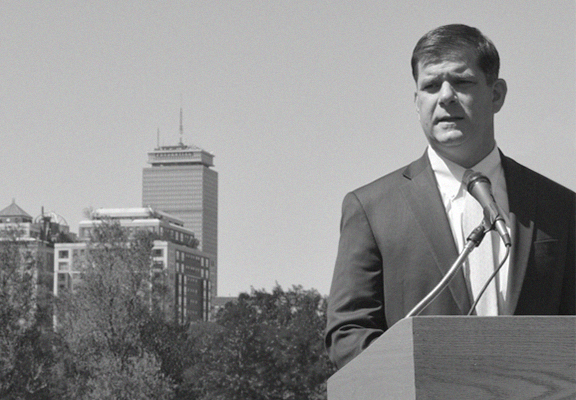
Mayor Marty Walsh  Photo from Bostoninno

Mayor Marty Walsh, photo from Bostoninno

Comments Off on New Age Old Town

READINGS FOR 2014

Posted on January 30th, 2014 by Katie Faulkner

Posted under: Things We Like

I have been passing some websites and reading back and forth with people and thought it might interest others out there.  So here it goes:

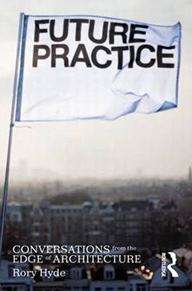
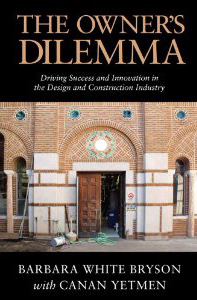
futurepractice ownersdilemma dezeen

grasp2molo

GRASP article is my favorite one so far.  I have read it about once a day for a week. Dezeen post on architects and social media is also an excellent read.  Browsing through Molo shop is inspiring.

Comments Off on READINGS FOR 2014

Farewell to Higgins Armory Museum

Posted on January 10th, 2014 by Katie Faulkner

Posted under: Things We Like

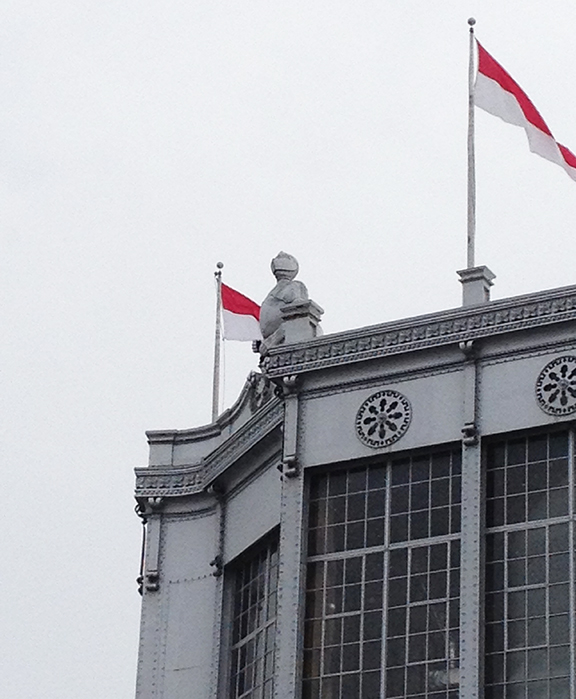
Many of you may know that on December 31, Worcester’s Higgins Armory Museum closed its doors after 83 years of operation.  This had been announced earlier in the year, and I scheduled a couple of visits to say our formal farewells.  The Armory has become a family favorite – both for its amazing exhibits and its overall strange existence. Anyone travelling north of Boston on I-90 has passed the steel and glass structure, festooned daily with billowing flags and a bowsprit knight.  If you did not ask yourself what it was doing there, shame on you.

It is unclear what will become of the 42,000 square foot building; the 24 suits of armor and incredible collection of oddities will integrate with the holdings of the Worcester Art Museum.  Apparently the Higgins had been running in the red for years, and they repeatedly turned down offers from major institutions to purchase the collection.  I can imagine that Higgins loyalists would not want to separate the armor from the building, the interior of which is nothing short of a medieval castle, with pointed arches, high stone ceilings, and several large steeds roaming the halls.

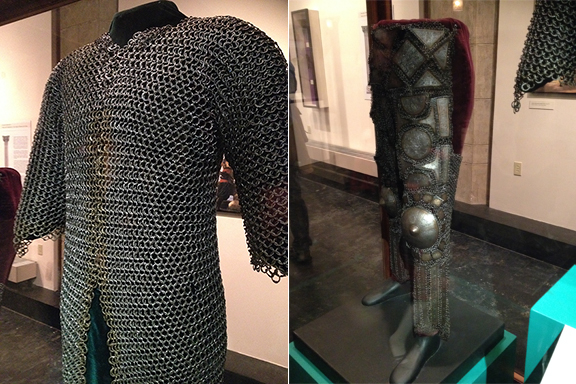
John Higgins was an industrialist who owned the Worcester Pressed Steel Company.  Suits of armor were his passion, and in 1929 he built a museum next to his factory, appropriately mannered with a steel exoskeleton over glass skin. Being in the building was a strange experience of traveling back and forth in time – cloisters and great halls on every floor connected by muscular steel and glass staircases.  But the greatest thing of course, has always been the collection.  I am a nut for chainmail, and there was a lot of it – not only with the 13th through 16th century European armors, but Asian and Middle Eastern as well.  While I have longed to wear it, mail (maille) weighs a ton which is why you only see it as something you would not be caught dead in, as furniture, or on runway mannequins. Maybe the 21st century laser-cut dress will allow us to put it back in style, clingy yet practical with just the right amount of sparkle.

My sons were always disappointed that John Higgins was not much into swords and other weaponry.  There is the odd battle-ax, lance and maul, but they are not the stars of the show.  The Higgins Armory was all about male fashion, and this kind of fashion needs no accessorizing. So if you can arrange a visit to the Armory building, run don’t walk.  Otherwise, visit WAM in the Spring when they launch their show “Knights!”
armory01

armory02

armory03

Comments Off on Farewell to Higgins Armory Museum

NOTES FOR THE NEW YEAR

Posted on January 6th, 2014 by Katie Faulkner

Posted under: Competitions

On January 2, NADAAA turned three years old, which seems as good a time as any to look back on 2013 and look forward to the New Year. While we never forget our legacy of Office dA, we annually set goals that surpass achievements and provide opportunity to expand our craft. Over the past year, the paramount objective remained to enable the designs to be built, with a close second being the expansion of our fabrication lab to both inform the design and support the first objective of GETTING IT BUILT. Thirdly, NADAAA continued to expand globally, with projects in Melbourne, Toronto, Villa Varoise. Tropez, and Kuwait. Closer to home, the office sought to more boldly occupy our Lower Roxbury address by renovating our storefront, as well as work with Urbanica toward the successful development of Melnea Cass’s Parcel 9. As a gift to both our peers and ourselves, we endeavored to invite the broader public to scheduled gallery shows as a way to inspire conversation and debate regarding the potential of Architecture. KuwaitHouse_SM

KUWAIT HOUSE: A complex residential organization, the result of nuanced mediation between public, private and services area.

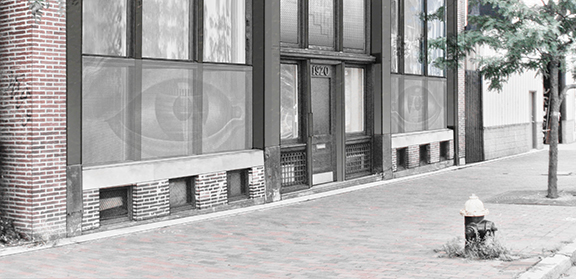
1920washington

1920 WASHINGTON ST: NADAAA facade opens up onto the street with eyes wide open.

Building the Parts and the Whole  Several projects were completed: Cornell Bridges, Beacon Street Residence, 57 East Concord, and SGH NY Office and Furniture. For Aesop USA, we delivered stores in East Hampton, Toronto, Venice Beach, San Francisco, and Hong Kong. This was the first year that we detailed, fabricated, and installed significant components of our design work, a trend that began with Aesop Toronto. During the last quarter of the year our team enjoyed the success of executing a full scale mock-up of a simple-to-install but complex-in-appearance gypsum ceiling – demonstrating to the Construction Manager the system’s feasibility, and resulting in a significant cost reduction of the sub consultant’s estimate.

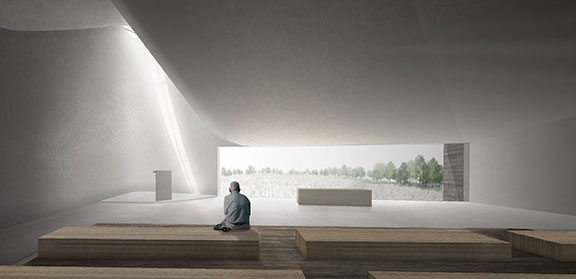
Reaching Globally  Architecture has always been an international profession, made more possible than ever through digital platforms and teleconferencing. New opportunities were explored in Saudi Arabia, Basra, and Tehran, while ongoing work continued in France. Two competitions were entered: a tower for Parramatta, Australia; and a chapel in Ireland. Phase One of University of Toronto, Daniels Faculty of Architecture, Landscape and Design broke ground in June; University of Melbourne Faculty of Architecture, Building and Planning proved to be moving well ahead of schedule with substantial completion anticipated in 2014.

CornellBridges_SM

CORNELL BRIDGES: Safety mesh barriers work in tandem with structural configurations to form a new figure over the ravines in Ithaca. Photo by John Horner

CentenaryChapel

CENTENARY CHAPEL: A concrete suspension structure forms the vault for the funerary space of mourning.

Working in the Neighborhood  We had mixed success in our own back yard. On the one hand there were multiple successful exhibits; we kicked off 2013 with PINNED UP, an exhibit demonstrating the developments of NADAAA’s work. In April, NADAAA introduced Drawing Surfaces: Computing and a Vintage Pen Plotter. The November show, Makers in the Making, featured the work of six MIT faculty who share a progressive stance toward their respective disciplines.

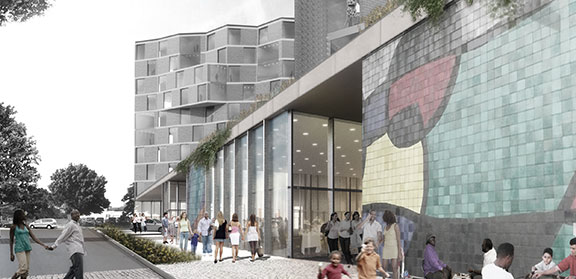
Becoming more involved in the urban design of our own city is a goal to carry forward. Watching much of the current Boston construction from the sidelines, we remain committed to proving that excellent design does not burden Project Costs. Like everyone else in town, we are watching the transformation of Dudley Square thanks in part to the renovated Ferdinand’s Building, and we remain confident that our block is not far behind. A small contribution will be the storefront development (the design for which is complete, provocative, and approved by the Washington Gateway Main Street) of our offices at 1920 Washington Street. A larger stake would be the commencement of Parcel 9, a mixed used development on Melnea Cass Boulevard featuring a hotel, housing, retail and underground parking.

Finally, the greatest achievement of 2013 remains the collective talent of NADAAA employees, who take the firm’s ambitions as their own, and somehow make possible the impossible. Their abilities, ingenuity, and hard work continue to amaze our clients as well and Nader, Dan, and me.

May all of you find as much joy in your work as we do in ours — Happy New Year from all of us at NADAAA.

Paramatta

PARRAMATTA: The Gemini Towers help to form a new skyline for Sydney, creating a new hybrid that engages the urbanism of the site.

PARCEL 9  DEVELOPMENT: Mixed-use block designed to create a public base with a residential and hotel mass above.

Parcel_9

Comments Off on NOTES FOR THE NEW YEAR

An Appreciation for the Extraordinary

Posted on December 2nd, 2013 by Katie Faulkner

Posted under: Things We Like

On the heels of our current exhibit, “Makers in the Making”, I have been preoccupied by the difference between concept and action.  Dozens of times during the week I am struck by small ideas: a chair refurbishment, a fantastic tree house, a mobile kitchen island, a rock garden. These are concepts that could be enacted upon, and even completed within the space of a weekend, yet they never get done. Things get in front of them, or they are written on a sketchbook page and soon forgotten.

Fortunately there are those who are driven to make.  Dedee Shattuck opened an eponymous gallery in Westport, MA a few years ago. It is a lovely, peaceful architecture, situated at the edge of a wooded area  Click here to go to the gallery website. I make an effort to visit each season, less for the art (which is generally excellent) than for the calming effect of the space which is an oasis after a few days with the extended family. The gallery is directly behind a wonderful shop/cafe, and usually I can leave the kids with my parents and steal a few minutes with the paintings and objects currently on exhibit. But this time the boys were with me and the moment we entered, I knew it was a mistake.  Now they are old enough not to break or damage, but “WHO would pay FIVE HUNDRED AND FIFTY DOLLARS for THIS??!” came through loud and clear, thanks to the excellent acoustics. Dedee graciously suggested my children might prefer to run around in the wooded sculpture garden, which turned out to be the sanity saving activity of the day.

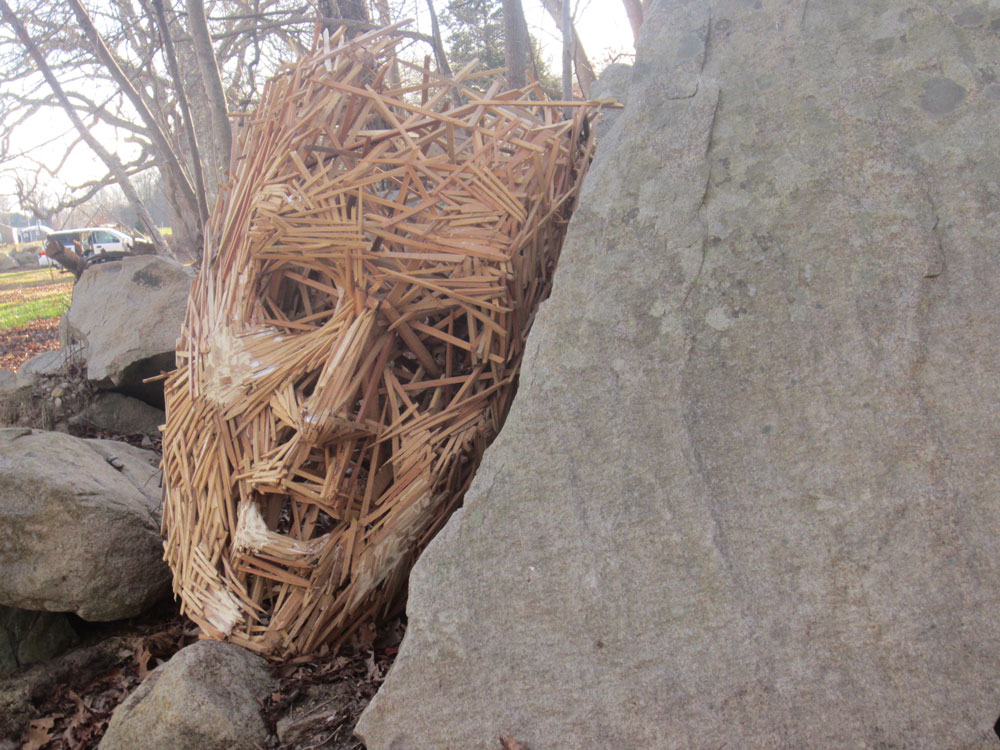
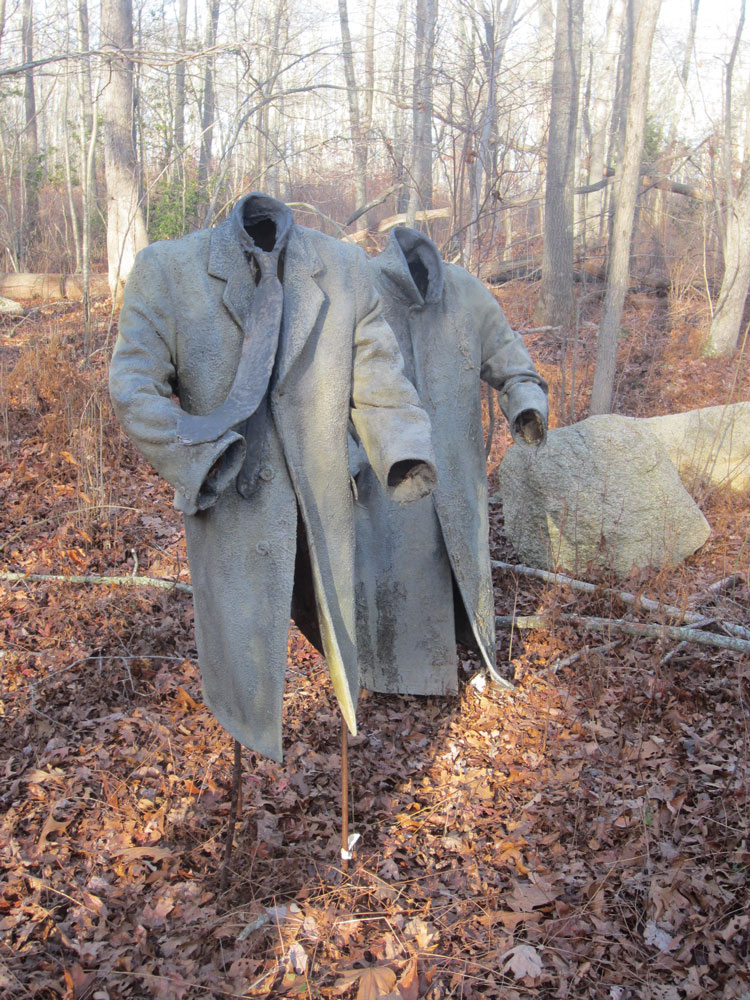
“Art in the Environment,” is an exhibition of work by faculty and graduate students from the College of Visual and Performing Arts at UMass Dartmouth. The setting is a winding path through a forest, where moss is still electric green among the brown leaves, and you cannot see the art until you happen upon it.  It is surprising to discover “Fall” by Russell Prigodich, an enormous leaf hovering in the air with no obvious means of support, and “Green Men” by  Ellen Lewis Watson, two hollow jackets floating without heads – a little bit “Blair Witch Trial” and a little bit Ichabod Crane, but somehow beautiful.  On your way out, you might miss Rob Greene’s “Down and Out” leaning against a boulder. It is a huge sad head made of sticks.

The strength to fully execute an idea is something to admire, and I suspect that architects can appreciate this as well as anyone.  Time and Money often seek to deny what was intended—and perhaps the bigger the idea, the more vulnerable it is to compromise.  Yet in spite of it all, some things make it through.  Enough people believed in an ICA, Community Rowing, Genzyme Center, and Hancock Tower to enable something remarkable to be built. And it is worth remembering that each time we consider renovation and/or development; it is easier to make something unremarkable, or to make nothing at all.  So within that context, I am grateful for those who would create beauty and provocation in a quiet back yard, for only a small audience to discover. And I ask myself if, as an architect, I am doing all that I
could?

shattuck-2

shattuck-1

Comments Off on An Appreciation for the Extraordinary

New Development in Our Neighborhood

Posted on March 7th, 2012 by Katie Faulkner

Posted under: Things We Like

In early February, a Roxbury Project Review Committee (PRC) voted unanimously to endorse Melnea Partners, including NADAAA, for the development of a City lot known as “Parcel 9.”

The mandate for the development was given by the 2004 Roxbury Master Plan, which called for projects that enabled wealth generation for the local community, honored a commitment to local and minority hiring, and provided both affordable and market-rate housing. The November 2011 decision to move the Boston School Department to the renovated Ferdinand Building in Dudley Square reflected the Plan’s foundational belief that land use and quality of life must be considered in terms of neighborhood economic benefit.

In addition to a credible financial plan, the three contenders for the development of Parcel 9 were required to project numbers of full-time jobs. During the public review process, teams were rarely questioned about design, and instead asked to specify salary ranges, community job prospects, and number of market-rate vs. low-income housing units. All teams had complicated financial models that included New Market Tax Credits, a federal incentive program offering tax credits to investors.

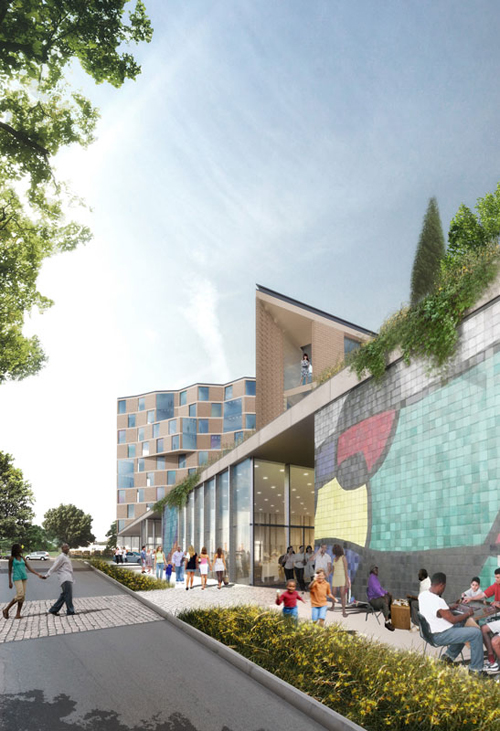
Within this discussion, NADAAA’s design for the Melnea Hotel + Residences presented itself as transformative. The 160-room hotel and 52 apartments were raised on a landscaped platform with views to the City. The ground floor, penetrable at many points, linked Dudley Square with Ramsey Park by means of a jazz club, restaurant, fitness center, and community hall. Renderings featured the structure’s dynamic form, pedestrians and cyclists traversing the site, convenient public transportation access, and active storefronts.

The Melnea team- architects, urban designers, developers, and community members- considered “shared value,” a concept described by economist Michael Porter as going beyond the success of a single venture to create societal benefit. Designers stressed the need for vibrancy and positive environmental impact, developers considered tenants and ROI’s, and members of the community researched career “ladder opportunities” for community low-skilled workers.

After the PRC announced support for the Melnea Hotel + Residences, The Bay State Banner quoted co-chair Jorge Martinez, “This will be a huge economic engine for the community … (I) can’t wait” for the development to begin. The Melnea team enjoyed the levity of celebration, but understood the real work has yet to begin.

Comments Off on New Development in Our Neighborhood