Nader Featured in Archinect’s List of Immigrants Expanding the Definition of American Architecture

Posted on July 4th, 2017 by Jalisa Joyner

Posted under: Things We Like

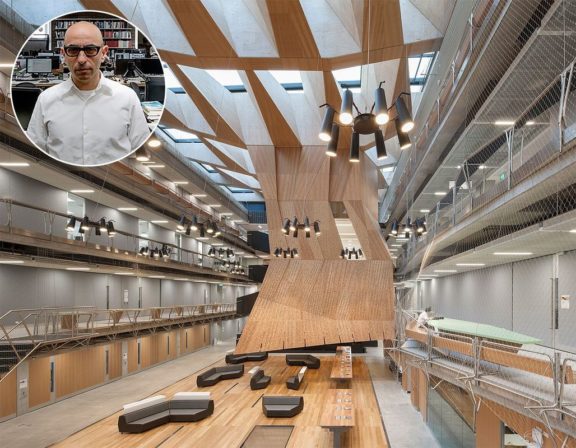
Archinect celebrated the Fourth of July by creating a list of Architects who’ve made significant contributions to American architecture after settling in the United States. Nader is joined by Moshe Safdie, Daniel Liebeskind, and Meejin Yoon, among others. Click HERE to read the article.

Comments Off on Nader Featured in Archinect’s List of Immigrants Expanding the Definition of American Architecture

NADAAA is seeking an Executive Assistant / Office Manager

Posted on June 8th, 2017 by Nicole Sakr

Posted under: Things We Like

more details are available HERE or contact Alana Folsom at afolsom@nadaaa.com

Comments Off on NADAAA is seeking an Executive Assistant / Office Manager

New York Architecture Diary

Posted on June 1st, 2017 by Nicole Sakr

Posted under: Academic, Press, Things We Like

Nader has curated a list of key NYC Summer Events for the New York Architecture Diary including the Cooper Union’s annual End of Year Student Exhibition and MoMA PS1’s exhibits of James Turrell and Jenny Sabin.

Comments Off on New York Architecture Diary

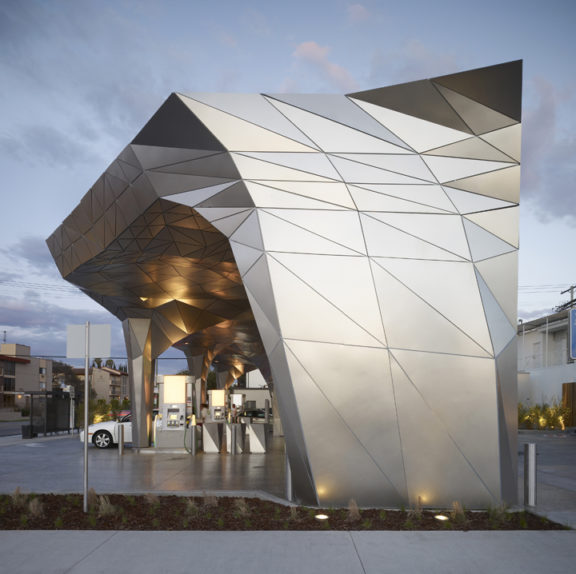
Helios House Featured in 2017’s 10 Best Gas Stations

Posted on May 19th, 2017 by Jalisa Joyner

Posted under: Press, Things We Like

Helios House was #8! Read more HERE.

Comments Off on Helios House Featured in 2017’s 10 Best Gas Stations

DFALD Preview at Doors Open Toronto

Posted on May 15th, 2017 by Jalisa Joyner

Posted under: _Daniels Building, Events, Things We Like

May 27 – 28, 2017

10:00am – 5:00pm, last entry at 4:00pm

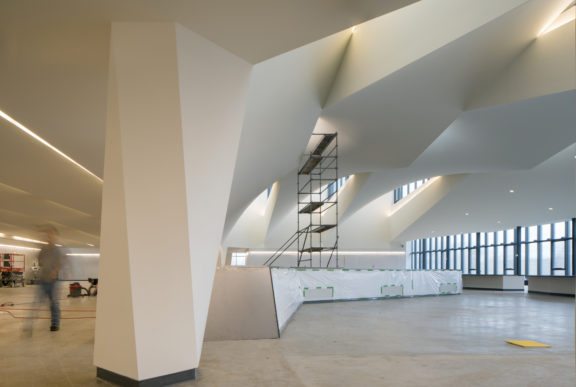
The University of Toronto’s John H. Daniels Faculty of Architecture, Landscape, and Design is opening the doors to One Spadina for the first public preview of its new building, now nearing completion. It will be added to one of the many popular tours offered by Doors Open. Read more HERE.

Directions: Use the East Entrance. Cross Spadina Crescent on the east side using the lights at Russell Street


Comments Off on DFALD Preview at Doors Open Toronto

Nader Selects His Favorite New NYC Architecture

Posted on May 10th, 2017 by Jalisa Joyner

Posted under: Press, Things We Like

Along with other architects, designers, and key influencers, Nader nominated his favorite recently constructed project in New York for Metropolis Mag.

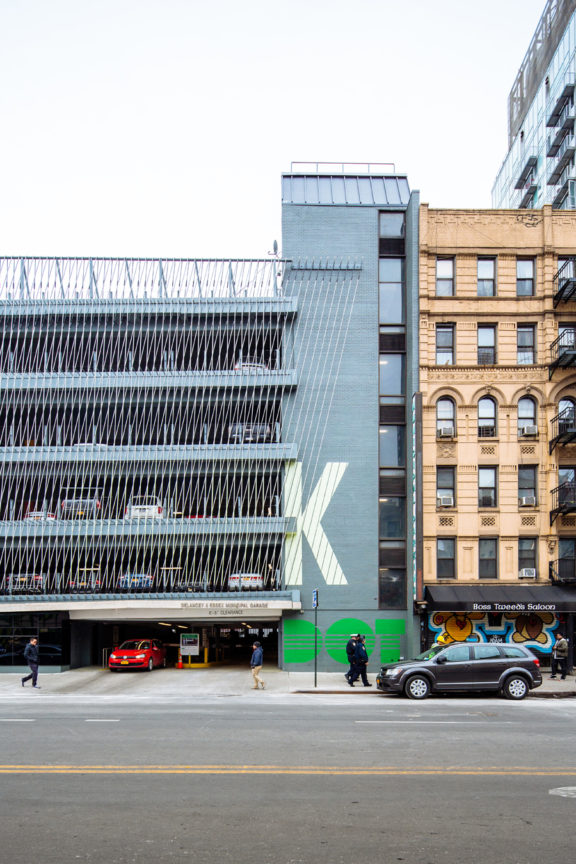
“As with all other cities, New York City is challenged by a range of buildings that may not have an overt civic or public function to be celebrated as such. At the same time, infrastructural projects such as parking structures often end up becoming one’s threshold into the city: a front door. This modest project, located in the margins of a main promenade, brings attention to a latent iconic and urban function such a threshold could contain, and it does it with a certain economy.”

Read more HERE.

DELANCEY AND ESSEX MUNICIPAL PARKING GARAGE
designed by Michielli + Wyetzner Architects

Comments Off on Nader Selects His Favorite New NYC Architecture

JOHN WARDLE AND STEFAN MEE SPEAK TO THE ARCHITECTURAL DISCIPLINE IN THE CONTEXT OF COLLABORATION

Posted on April 13th, 2017 by Jalisa Joyner

Posted under: _Melbourne School of Design, _Tanderrum Bridge, Things We Like

In an interview with Architecture and Design AU, John Wardle and Stefan Mee (JWA) discuss the trajectory of their practice and the role of collaboration within the architectural discipline. Read more HERE.

“THE STORY OF OUR RISE THROUGH VARIOUS PROJECT SCALES INTO THIS TERRITORY THAT WE NOW INHABIT IS A STORY OF RELATIONSHIPS WITH PEOPLE, THAT HAD THE CONFIDENCE TO ENGAGE WITH US. AS WE’VE GROWN, WE HAVE LOOKED VERY CAREFULLY AT INVITING OTHERS INTO THE PRACTICE THAT HAVE HAD PARTICULAR SKILLS, ALWAYS BROADENING OUR RANGE.”

-John Wardle

Comments Off on JOHN WARDLE AND STEFAN MEE SPEAK TO THE ARCHITECTURAL DISCIPLINE IN THE CONTEXT OF COLLABORATION

Reflecting on Victor Lundy and ‘Beyond the Harvard Box’

Posted on February 16th, 2017 by Nader Tehrani

Posted under: Academic, Things We Like

Lundy At The Warm Mineral Springs Motel

Curated and prepared by Michael Meredith, the ‘Beyond The Harvard Box’ exhibition and Symposium, now a decade old, included a range of critical voices from the Modern era –among them, Edward L. Barnes, John Johansen, I.M. Pei, Ulrich Franzen, Paul Rudolph and Victor Lundy– whose voices were an important part of the evolution of the canons to which they responded.

Watch the full symposium here: Part 1 / Part 2
01

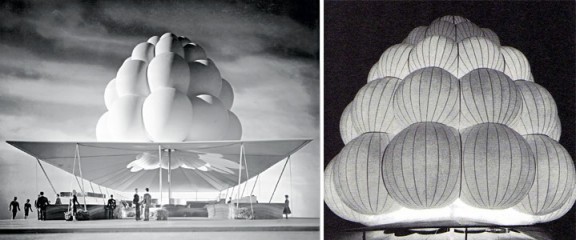
Air Flowers, New York World’s Fair, 1964

Of them all, Lundy stands out for his persistent attention to material agency: the careful engagement of material technologies as the prerequisite to design. What Lundy’s work demonstrates is the possibility that rules of composition, whether classical or modern, do not necessarily need to preempt design approaches, but rather that the discrete and incremental unit of material organization can become the DNA that enables multiple compositional predispositions. For this reason, even though many of Lundy’s buildings manifest well-known figurative and monumental strategies, they also reveal how material units offer many alternative formal, spatial and organizational potentials.
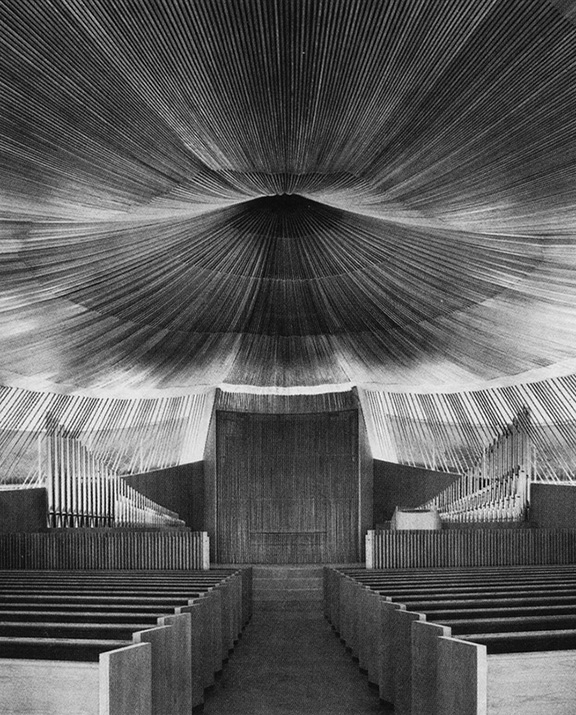
02

Unitarian Meeting House, Hartford, Connecticut, 1964
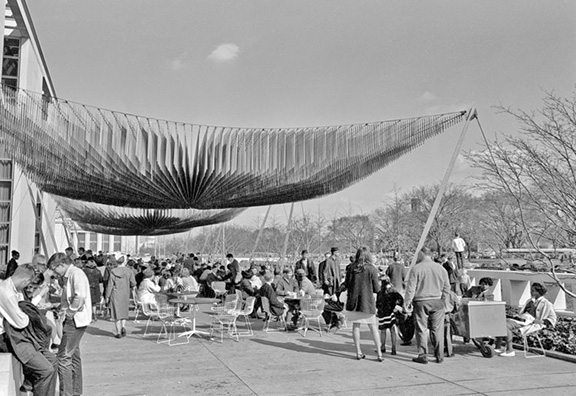
OPA-1019-14

Canopies, Museum of History and Technology, now known as the National Museum of American History, c. 1967

The work itself is also characterized by an authorship that denies signature in the form of a common style or singular voice; instead each project achieves a material sensibility that emerges from operations on material behavior, methods of aggregation, and their requisite formal malleability. As such, its part to whole relationships enjoy the same precision as Mies Van der Rohe’s work, but its formal and figurative ambitions are more aligned with the type of exploration that Le Corbusier might have entertained. At the same time Lundy’s materiality suggests a texture and density that only Aalto would have engaged, but in Lundy’s hands it is much more intellectually targeted and materially restrained. These composite characteristics make Lundy less prone to easy characterization and, in turn, less consumable. In great part, this is why he did not reach the pantheon of the great modernist architects or achieve a wider audience, but if seen from the viewpoint presented here, he exemplifies a paradigmatic position that in hindsight has become a classic.
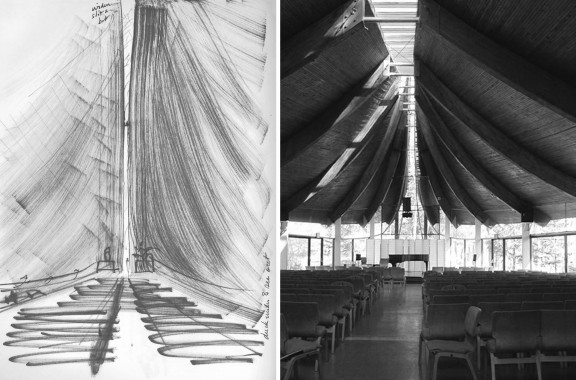
06

First Unitarian Church, Westport, CT, 1960
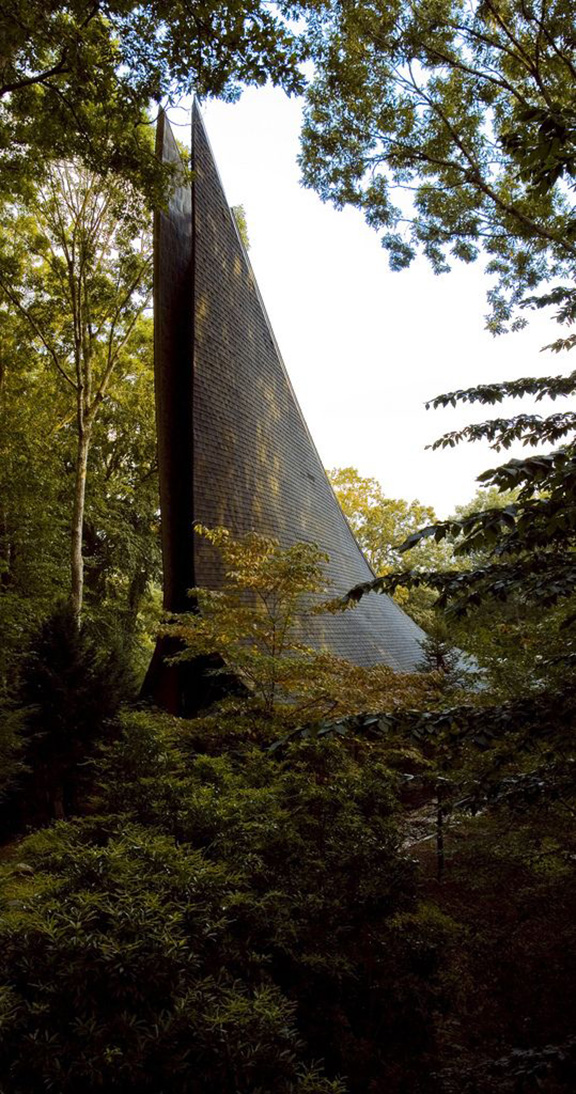
Lundy-9

From the perspective of our own research, the connections are obvious, but one can extend this lineage to protagonists like Herzog & de Meuron before us who realigned thinking in relation to materials— to a younger generation of architects after us, like Skylar Tibbits who have been rethinking material behavior at the molecular level. Looking back at the video of the Symposium, what is startling, and humorous, is my desperate attempt to draw out this thesis from Lundy himself, alas to futility. His intellectual project is implicit, even in those moments when he refutes them, or so I hope, as they emerge from the precise constructive composition of the work itself.

04

IBM Garden State Office, Cranford, NJ, 1965


Comments Off on Reflecting on Victor Lundy and ‘Beyond the Harvard Box’
‘ENTRELAC’ RECYCLED INTO BLANKETS FOR SYRIAN REFUGEES

Posted on January 31st, 2017 by Katie Faulkner

Posted under: Installations + Exhibitions, Things We Like

entrelac blanket_576

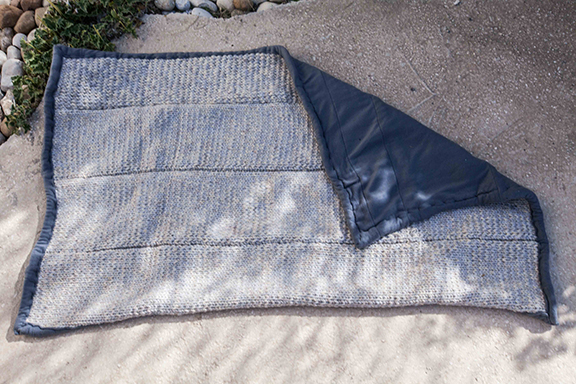
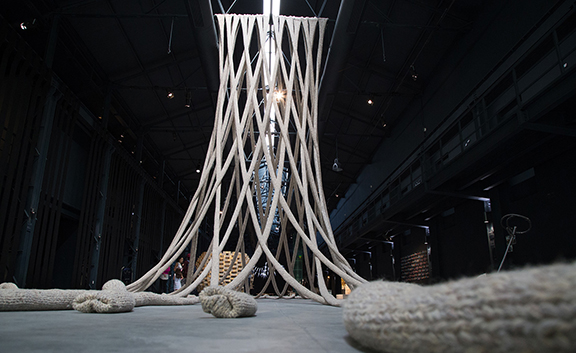
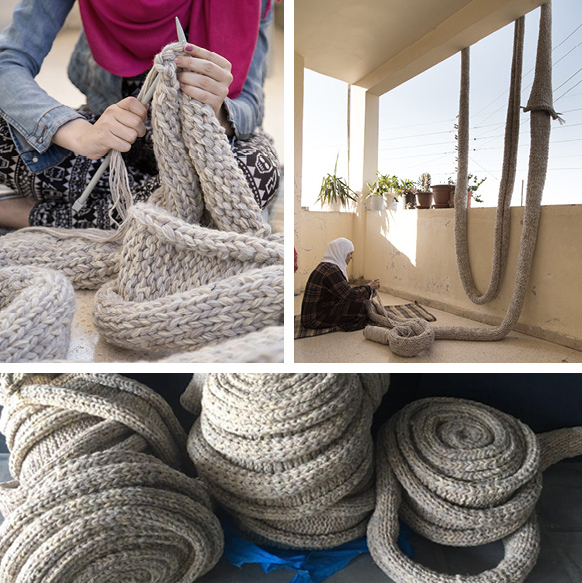
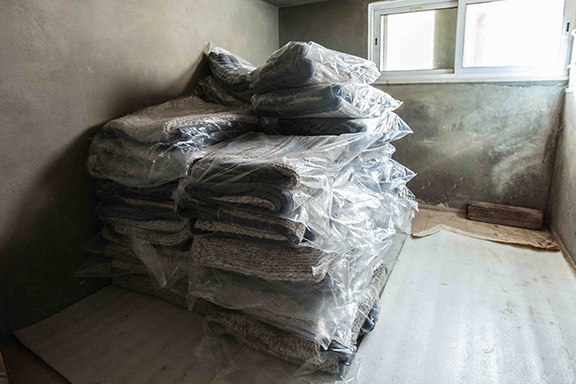
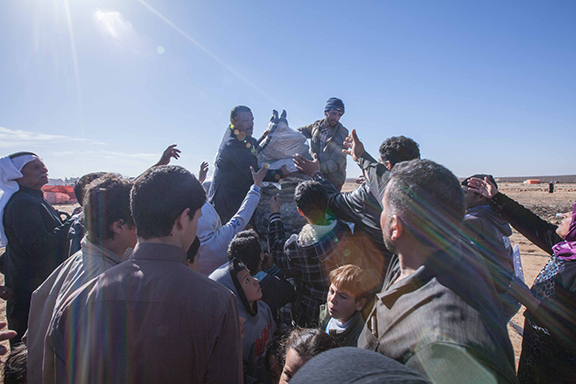
With support from NADAAA, Raya Kassisieh and the Amman Design Week team took the initiative to recycle “Entrelac”, cutting and stitching it into blankets that were later distributed to Syrian refugees and Jordanian families.  The original installation, included in the week-long event during September 2016,  consisted of 300 kg of un-dyed wool, hand knit and hung from the roof structure of Amman’s Electric Hangar. The design team utilized computational modeling to determine an approximation of the knit fabric ‘structure,’ which was then hand-knit by a team of twenty Jordanian women. Grounded less in precise digital production than in hand-craft and garment-making, Entrelac was simply “scaled up” to dress its venue, slung from the the standing roof trusses, and draped gracefully onto the floor.

entrelac_wallpaper_576

ENTRELAC process 8-3

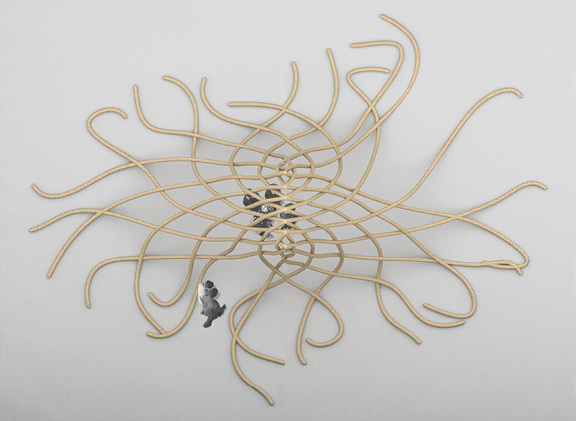
Twenty-eight large knit strands were produced, which were hung from the existing structure and again woven in a traditional Palestinian single X, at a larger scale, to form an enclosure. 
1

ENTRELAC process 6-2_WIDEN_576

The craftswomen skillfully and carefully knit each strand of the exhibit in their homes and small workshops. This network of domestically scaled production allowed for Entrelac’s rapid installation within the Electric Hangar exhibition hall. 
 

The notion of the re-purposing the installation is at once humbling and inspiring –  humbling because most of us do so little in the face of this tragedy that we are able to proceed unaffected during the quotidian replay of our lives. Yet this small act reminds us that humanity exists as a chain of relationships; someone had an idea, called some friends, momentum was built, and Amman Design Week was launched.  Someone else had an idea to weave the yarn of Entrelac into a global story that ended in a gesture of humanitarian assistance.  No more difficult than most tasks architects balance on a regular basis.

IMG_6702

IMG_6766_576 PI

Thank you to Raya, Rana, Abeer, Sahel, and all of the others at Amman Design Week who remind us what it means to be both a designer and a human being.

More photos HERE.

©2016 Amman Design Week. Photo: Hareth Tabbalat

Comments Off on ‘ENTRELAC’ RECYCLED INTO BLANKETS FOR SYRIAN REFUGEES

RISD MAKES 15 MOST BEAUTIFUL COLLEGE LIBRARIES IN AMERICA

Posted on January 19th, 2017 by Jalisa Joyner

Posted under: _RISD FLEET LIBRARY, Press, Things We Like

RISD RESIZED_576 PI

The RISD Fleet Library made Thrillist’s list of the 15 most beautiful college libraries in the country!

Read more HERE.


Comments Off on RISD MAKES 15 MOST BEAUTIFUL COLLEGE LIBRARIES IN AMERICA